

The Invercharron Gathering and the unique Kenny's Games
Third part of the History of Highland Games in and around the Kyle of Sutherland area written by Alasdair MacDonald.
Alasdair MacDonald, Historian for the Royal Scottish Highland Games Association, concludes his trilogy concentrating on the better-known Invercharron Gathering and on Kenny’s Games.
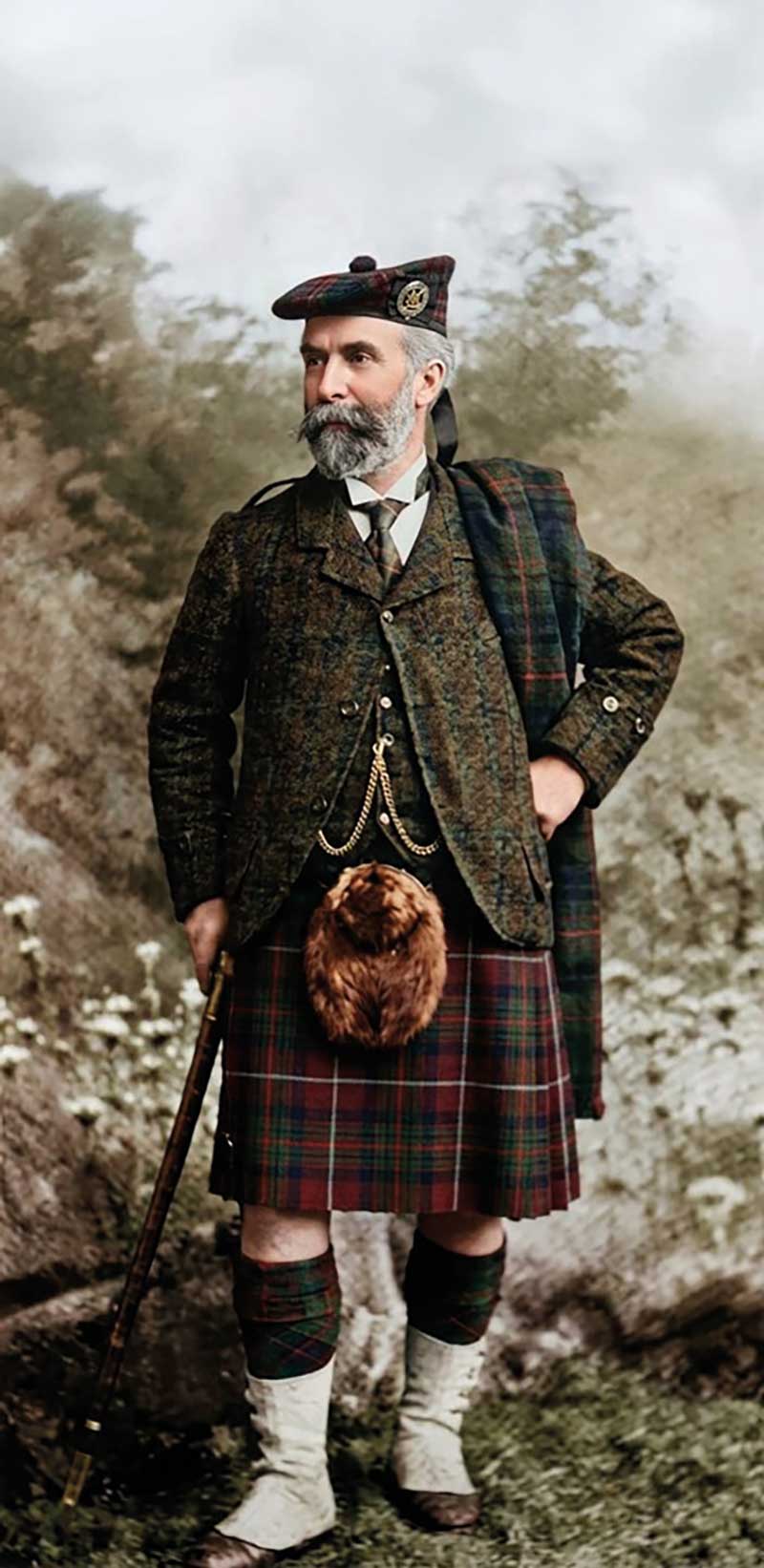
Integral to the founding of the Invercharron Gathering, was Mr Alexander Littlejohn J.P., D.L., who purchased the Invercharron Estate in 1881, for the reduced price of £30,000. A native of Aberdeen, he initially studied medicine at its university, before moving to London. He then became head of the firm of Alexander Littlejohn & Co. and was a member of the Stock Exchange Committee.
Though Highland Games were first held in Ardgay in 1875, the first Games/Gathering to take place on the Invercharron Estate were held on 12th January 1883. The new owner of the estate, Alexander Littlejohn, subscribed £10 towards the event. The venue was a field beside Culrain school, about two miles away from Invercharron House. Mr Littlejohn continued to support the Culrain Games (see previous edition) by subscribing 10 guineas in 1884 and 1885, when they stopped. The seeds were sown for future Invercharron Games.
On 1st January 1887, a game of Shinty was held in a field below Seafield Cottage, Ardgay, kindly granted by Mr Macleod of the Balnagown Arms Hotel. The team captains were Mr Murray, Stationmaster and Mr Alex. Ross, Seabank Cottage. Upwards of 100 players took part and Mr Ross’ team won by 3 goals to 1. Just two days later, Highland Games were held in a field below Invercharron House, Ardgay, for which Mr Littlejohn paid a subscription of 10 guineas. Thus started the first of many Invercharron Highland Games. The competitions were restricted to the parish of Kincardine, inclusive of Easter, Mid, and Wester Fearn in Edderton. The events were: Heavy and Light Hammer, Heavy and Light Stone, High Jump, Long Jump, Pole Vault, Short Race, Long Race, Hurdle Race, Sack Race, Highland Dancing, Boy’s and Girl’s Races. A 10 men a-side Tug- of-War competition took place between Married and Single Men, resulting in a win for the single men. To celebrate Queen Victoria’s Golden Jubilee on 21st June, athletic Games were held near the summit of Ardgay Hill - since then sometimes called “Jubilee Hill”. About 600 people attended the event, which was funded by Mr Littlejohn and other local dignitaries.
On 2nd January 1888, the ‘Kincardine Annual Games’ were once again held at Invercharron. Piping was an additional event from the previous year. Mr Littlejohn was the principal subscriber. These, the second Games to be held at Invercharron House, were previously thought to be the founding of the Invercharron Games, when they were revived in 1981.
On 1st January 1889, under the auspices of the Kincardine Athletic Sports Association, “The Invercharron Highland Gathering” took place in a park adjoining Invercharron House. Though a keen frost prevailed, it was considered that the weather was exceptionally favourable. For the first time, there were ‘Local’ and ‘Open’ events. The prize winners of the various events came from Syall, Carryfern, Invercharron, Kilmachalmaig, Kincardine, Ardgay, Balchraggan, Culrain, Torry and Tain. Mr Littlejohn donated 10 guineas to the event and a telegram written by him at his London address was read out.
On 5th September 1890, Invercharron Highland Gathering was once again held at Invercharron. As this was within the shooting season, Mr Littlejohn attended the Games for the first time, accompanied by his wife and daughter. Amongst the numerous guests were His Grace the Duke of Sutherland, the Duchess of Sutherland, His Grace the Duke of Westminster and many other distinguished people. The events were more or less similar to the previous years, with the addition of Pony and Horse Races and a Bayonet Exercise Competition. In his speech, the Secretary said that there were present “the peerage and the peasantry, landlords and land leaguers, preachers and pipers, gaugers and smugglers.” A supper and ball were later held at Invercharron House.
Though the Littlejohns did not attend, further annual Games were held at Invercharron House in 1891, 1892 and 1893. By this time the races were over specific distances. There was a Best Dressed Highlander event in 1891. The Dornoch Brass Band played in 1892, at which time Caber and Wrestling competitions were held for the first time.
Mr Littlejohn and family attended the 1894 Invercharron Games. New to the event, was a greasy tailed pig chase. Knitting competitions for Stockings and Knicker Hose were also held.
The 1895 Invercharron Games had the following events: Locals – Throwing a 16lb and a 13lb Hammer, Putting a 16lb Stone, a 600 Yard Race, an under 13 Boys’ Race, an under 14 Girls’ Race, a Soldiers’ Race, Piping, Highland Dancing and a Horse and Pony Race. Open – Heavy Hammer, Heavy Stone, Caber, a 200 Yards, a 600 Yards and a 1 Mile Race, Hurdle Race, Obstacle Race, Long Jump, High Jump, Pole Vault, Piping, Highland Dancing and a Pig Chase.
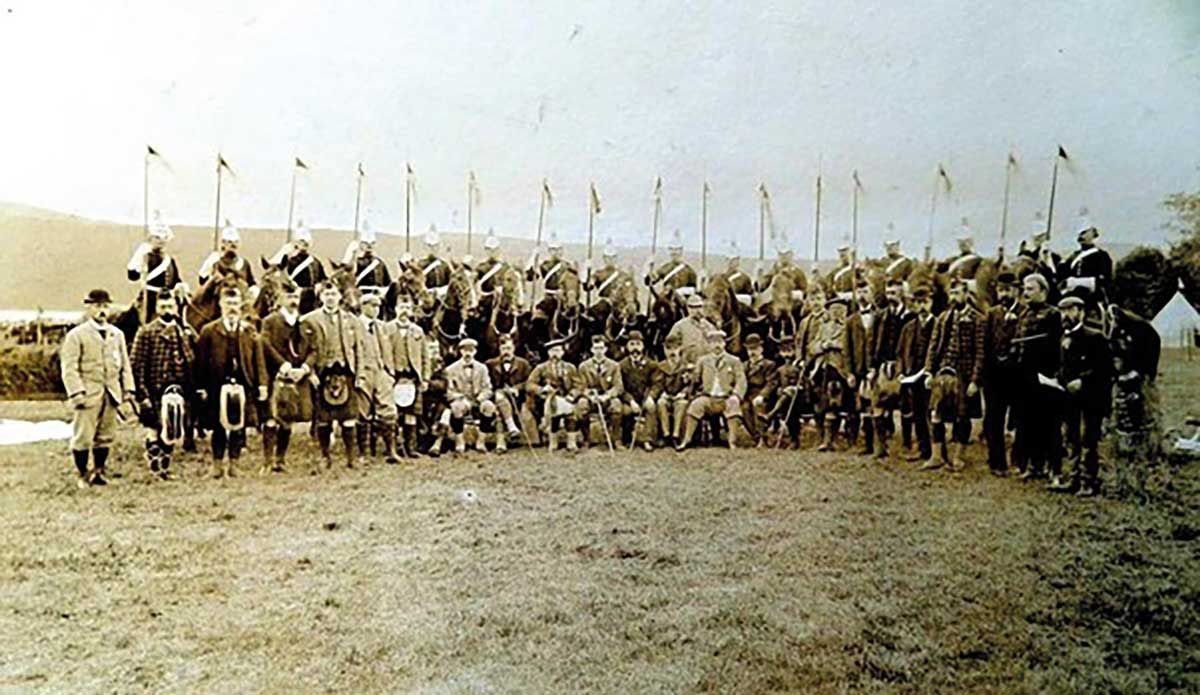
The programme of the 1896 Invercharron Highland Games was boosted by the attendance of a detachment of The Inniskilling Dragoons, which were brought specially to the north by Mr Littlejohn at considerable expense. Unfortunately Mr Littlejohn had fallen ill just prior to the Games and was unable to leave London. Between 6,000 to 7,000 spectators attended to witness the entertainment on offer. The Dragoons put on a magnificent display of military skill and discipline. Other new events to the programme were a Bicycle Race and a Band Race. A photographer was present on the field.
Mr Littlejohn and his family attended the 1897 Invercharron Gathering. Refreshments were served in a new 140-foot long marquee. Other ‘temperance’ tents were also on the ground, to cater for the 6,000 to 7,000 spectators. The Dingwall Ambulance Corps attended, with their new ambulance, which Mr Littlejohn had recently presented to them. It was crewed by staff from the Ross Memorial Hospital. Both Local (confined to Ross, Sutherland and Caithness) and Open events took place, including the greased tailed pig chase. The military events were: A Band Race, Heads and Posts, Lemon Cutting, Tent Pegging, Victoria Race, Cigar and Umbrella Race and Jumping by Half Sections. Mr Munro, Dingwall, took photographs during the day.
The 1898 Invercharron Gathering mirrored the 1896 event, featuring a military display by 16 mounted members of the Royal Scots Greys (2nd Dragoons). New to the gathering was the ‘Salute to the Flags’. 58 flags were placed around the perimeter, and each flag was saluted by a military party, preceded by Sutherland pipers, who played “The Invercharron Gathering”. As the party gave their salutes, the band of the Scots Greys played the corresponding National Anthems. Five Military Events were added in addition to the customary Local and Open events. The Scots Greys gave displays of a Musical Ride, a Lance Exercise and the plaiting of the May-pole. The final event was the Pig Chase.
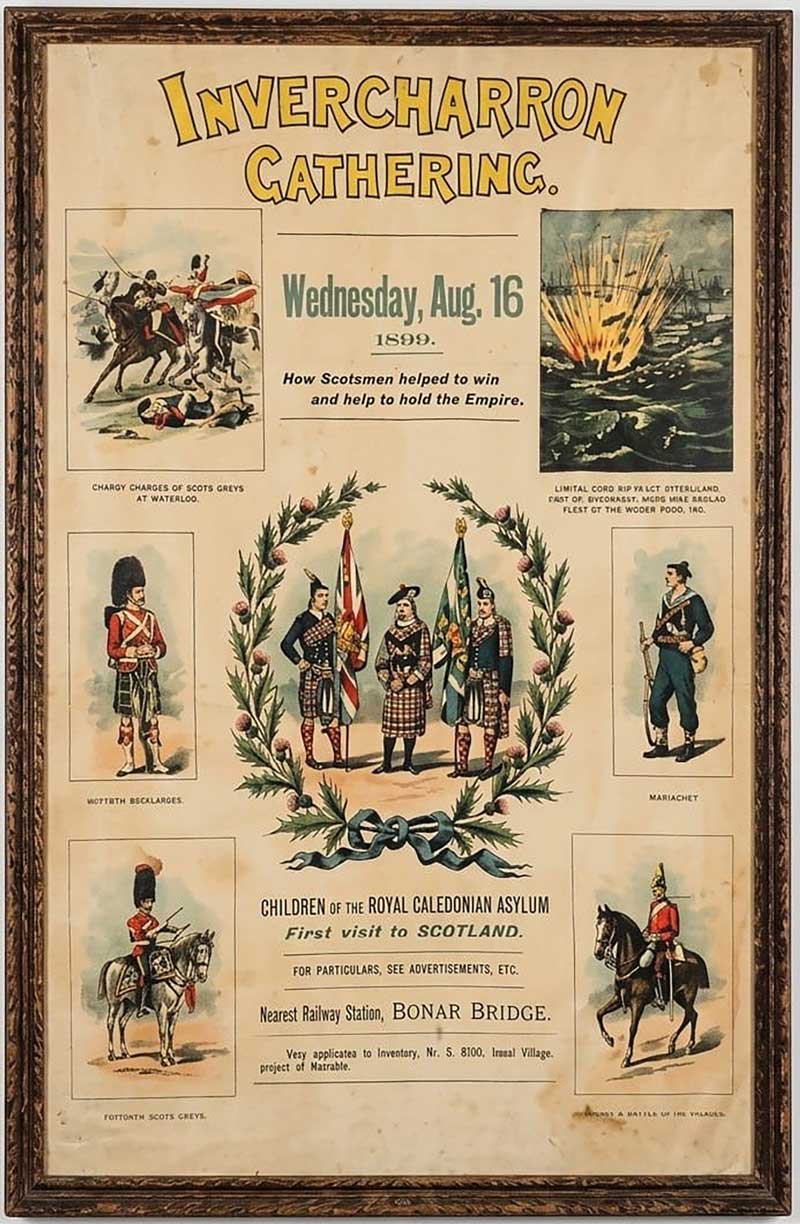
The 1899 Invercharron Gathering was the last one that Alex Littlejohn ever attended. Once more a ceremonial ‘Salute to the Flags’ took place. Children from one of Mr Littlejohn’s charities, the Royal Caledonian Asylum, London, also attended, for whom a new flag was displayed and races for boys and girls from the asylum were added to the customary Local and Open events. Military events were also included, with the Pig Chase as the final event.
Due to the ongoing Boer War, the 1900 Invercharron Gathering was cancelled.
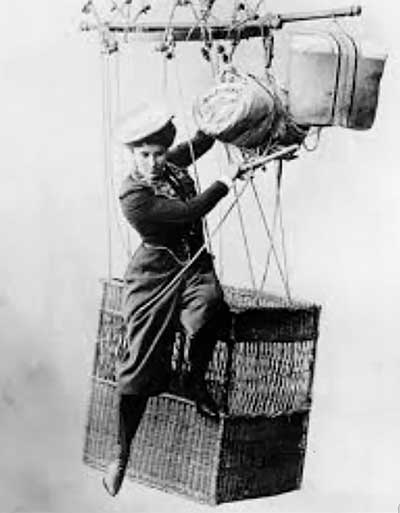
In 1901, in front of 8,000 to 10,000 spectators, Captain Percival Spencer parachuted himself from a balloon 4,000 ft in the air and landed about a mile away from the Invercharron Gathering’s park
In July 1901, local newspapers reported that Mr Alexander Littlejohn of Invercharron had severed his connection with the management of the Invercharron Gathering, for which he was no longer responsible in any shape or form. On 21st August the last Gathering to be held at Invercharron took place as normal, but without ‘Salute to the Flags’. It was reported that an enormous crowd of between 8,000 to 10,000 people attended. The Scots Greys attended from Edinburgh, and a gymnastic team by the Seaforth Highlanders and its regimental band came from Fort George. The most interesting event was a parachute descent from a balloon 4,000 feet in the air. The aeronaut, Captain Percival Spencer, successfully landed about a mile away from the park. The traditional events were once more finished with a Pig Chase.
On 22nd August 1902, the Invercharron Gathering took place in a field near Ardgay Railway Station. About 7,000 people attended. As well as the customary events, a Horse Race took place on the sports field, but there was no Pig Chase. It was deemed essential to the success of the Gathering that a military display be included. About 50 Seaforth Highlanders attended and gave several displays.
The star of the show, however, was a parachute jump by Miss Viola Spencer, whose real name was Edith Maud Cook. She was a business partner of the previous year’s aeronaut, Captain Spencer. Concerns grew as the balloon rose into the clouds and was blown towards the northern end of the Kyle. After a while, she was seen swinging from her parachute, but was being blown further away. As she had not made an appearance by nightfall, Captain Spencer and others, with growing concerns, began a search for her, which continued until midnight, without success.
When the despondent searchers returned to Bonar Bridge, their fears were set to rest, as Miss Spencer had returned safely to the village. She had been blown about five miles off course and had safely landed on a 1,000 ft hill in the Lairg direction. A local had seen her land and had taken her to his house, where he gave her a cup of tea, before taking her back to Bonar Bridge. It took several men all day Saturday to find her balloon, which was then carted back to the railway station.
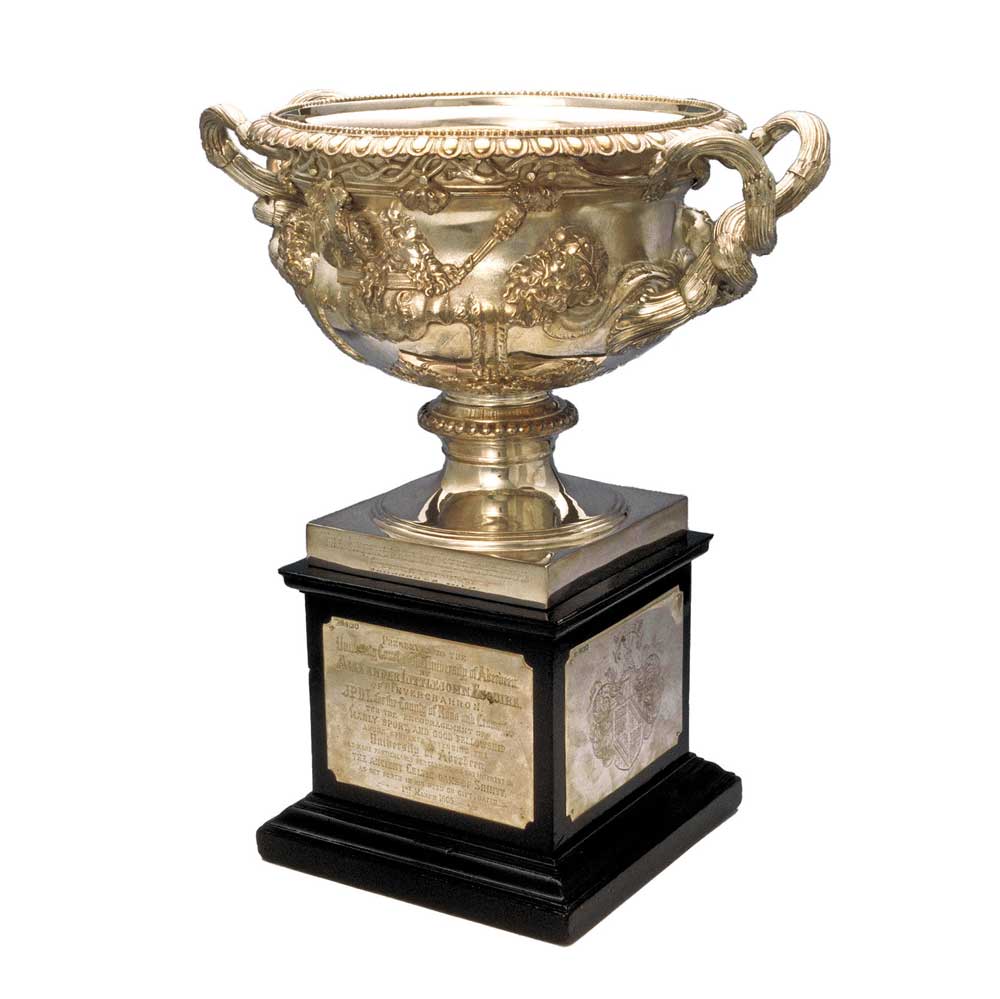
Littlejohn trophies
Though Alexander Littlejohn was no longer involved with Highland Games in the Kyle of Sutherland area, it is deemed worthy to note that in 1904, he became a Patron of the Strathpeffer Highland Gathering and donated the magnificent “Littlejohn of Invercharron Challenge Cup”, which was used for their Tug-of-War competitions.
Continuing with his encouragement of sport, in 1905 he donated “The Littlejohn of Invercharron Challenge Vase”, which was for an annual shinty competition between Scottish universities. He also gave the university “The Littlejohn Album”, detailing the history of shinty. On 16th July 1906, he donated “The Littlejohn of Invercharron Life Saving Trophy”, a.k.a. the Man Overboard Prize, to Invergordon Boating Club. These trophies are reputed to be among the best sports trophies in Scotland.
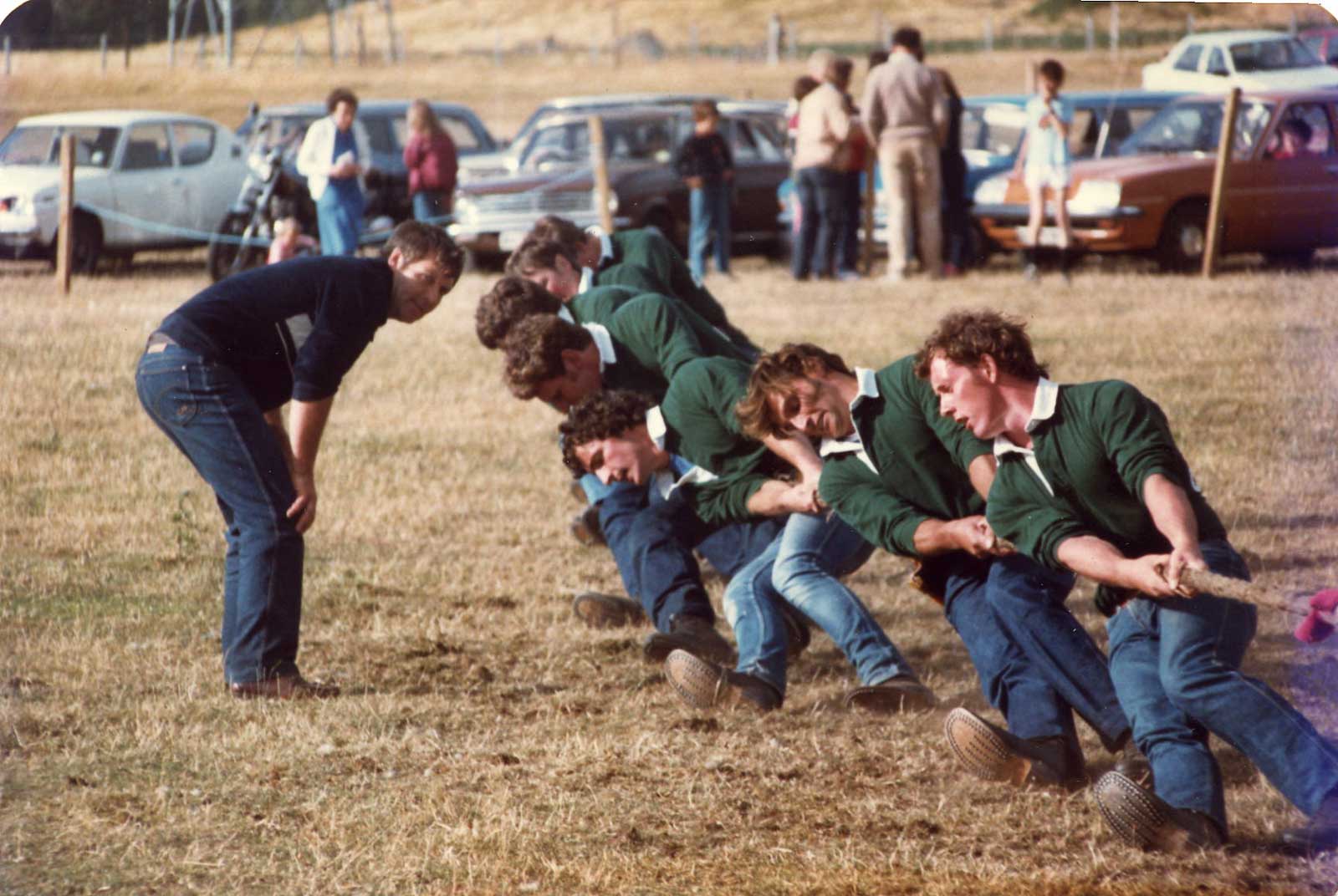
Kenny’s Games
In August 1978, Highland Games took place in Ardgay. They were held at Kincardine Croft and were affectionatelly called “Kenny’s Games”, after their founder Kenny Campbell, a well-known local strongman. Kenny is also renowned for his charity work which included, on different occasions, carrying a church organ, a plough, a full beer barrel and a gas cylinder up Ben Nevis. He also walked from Bonar Bridge to Tain and back, whilst carrying a 56lb weight. He later carried the 56lb weight on a walk from Wick to Inverness, and also pulled a 4 cwt (over 200 kg) horse-cart from Inverness to Aberdeen – all to raise funds for charity.
No prize money was given at Kenny’s Games, though trophies and other prizes were awarded. All monies raised were donated to Kenny’s charity of choice, Cancer Research. Included in the programme at the inaugural Kenny’s Games, were Heavy Events, Track and Field Events, Highland Dancing and Piping. Added to those, there were a few unique events, such as lifting and carrying pianos and then racing with them. Chanty pot slinging was also a regular event, though thankfully they were emptied beforehand. Hill Racing and Tug-of-War competitions were also held.
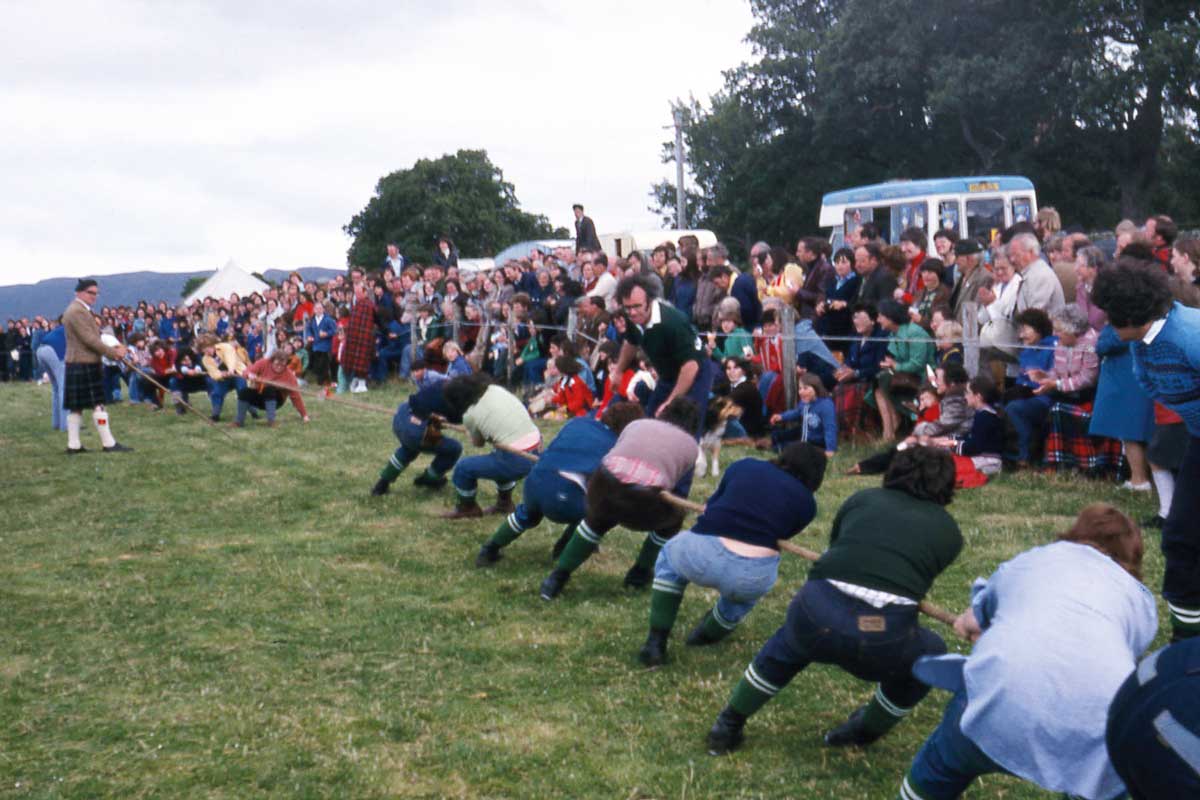
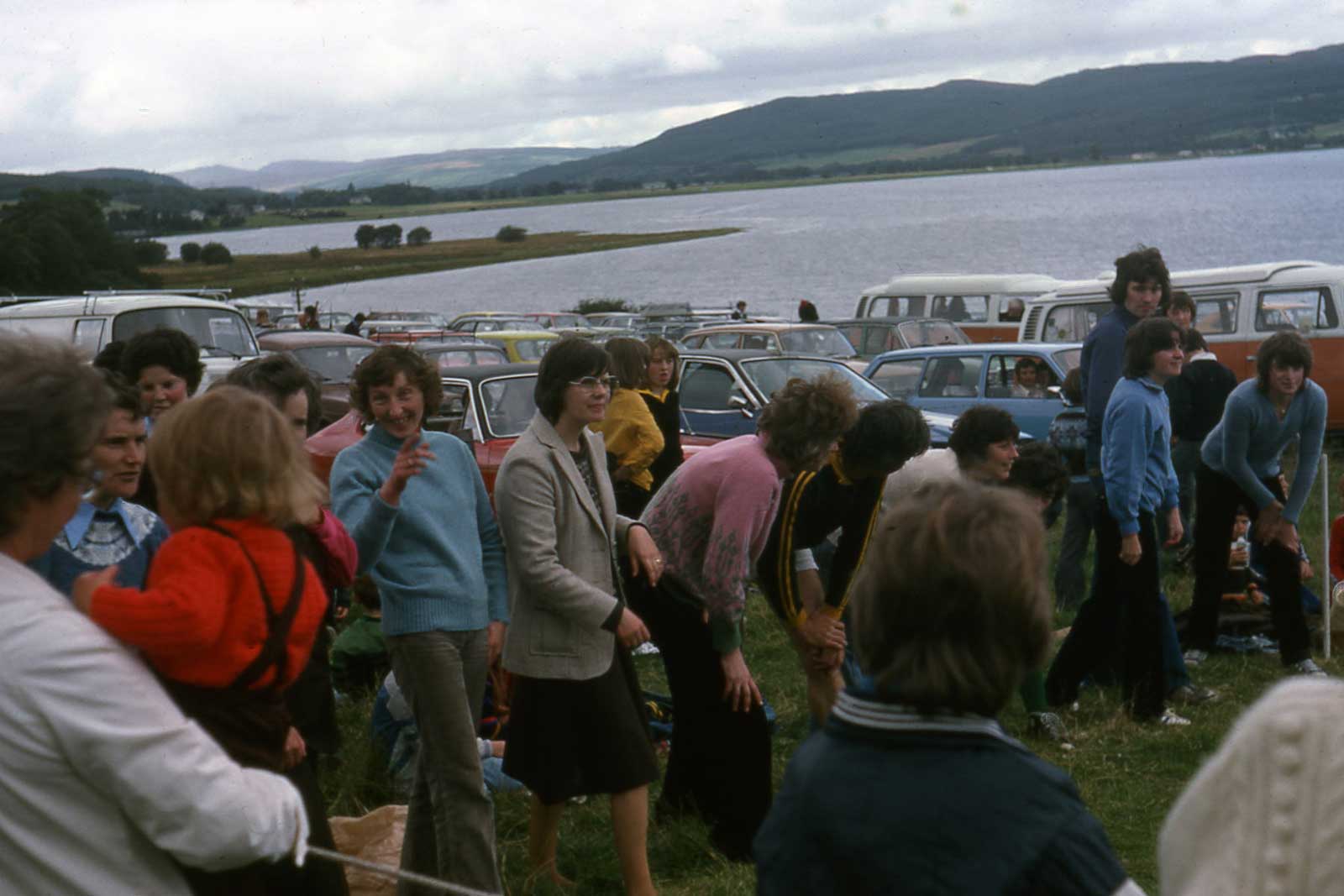
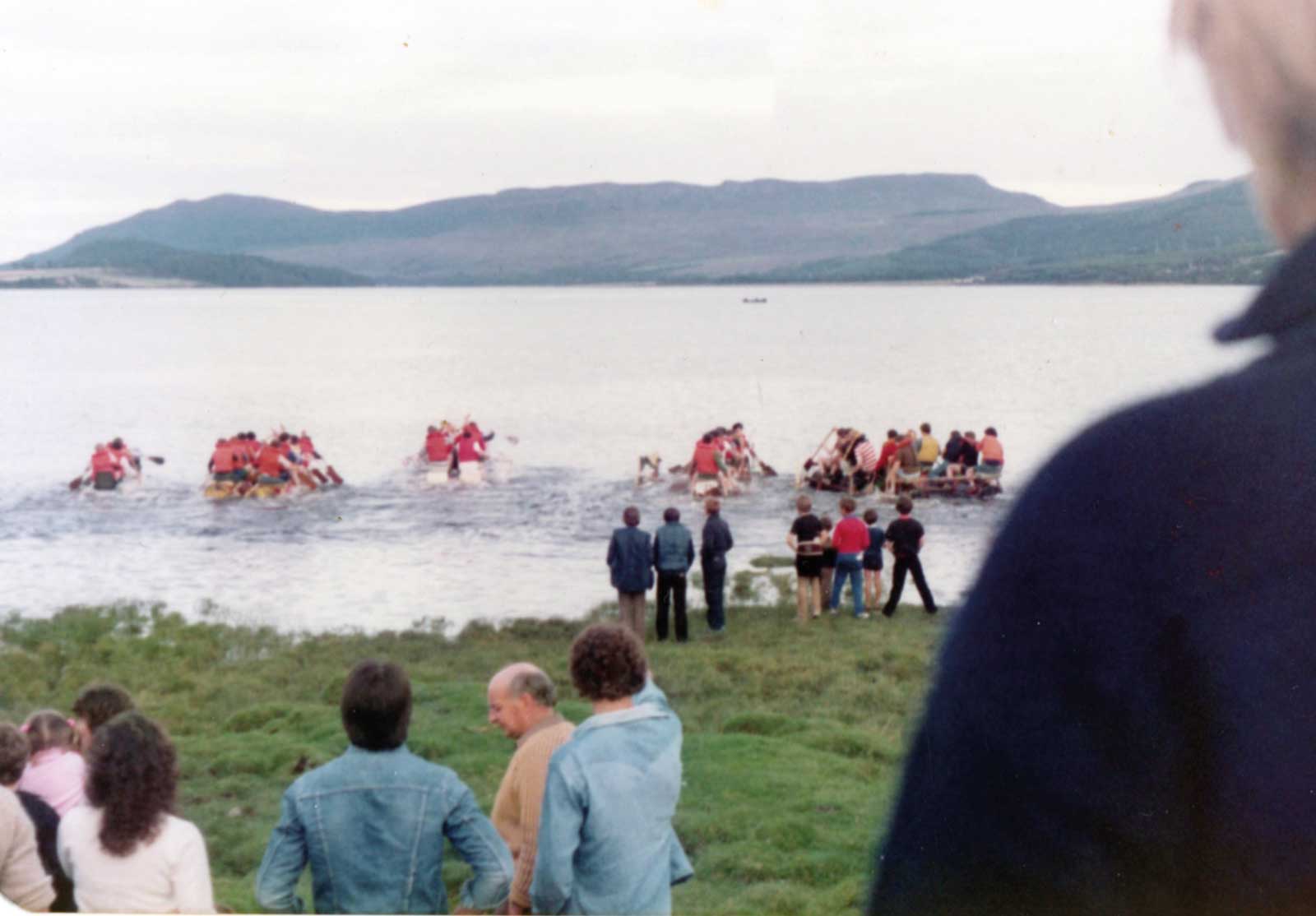
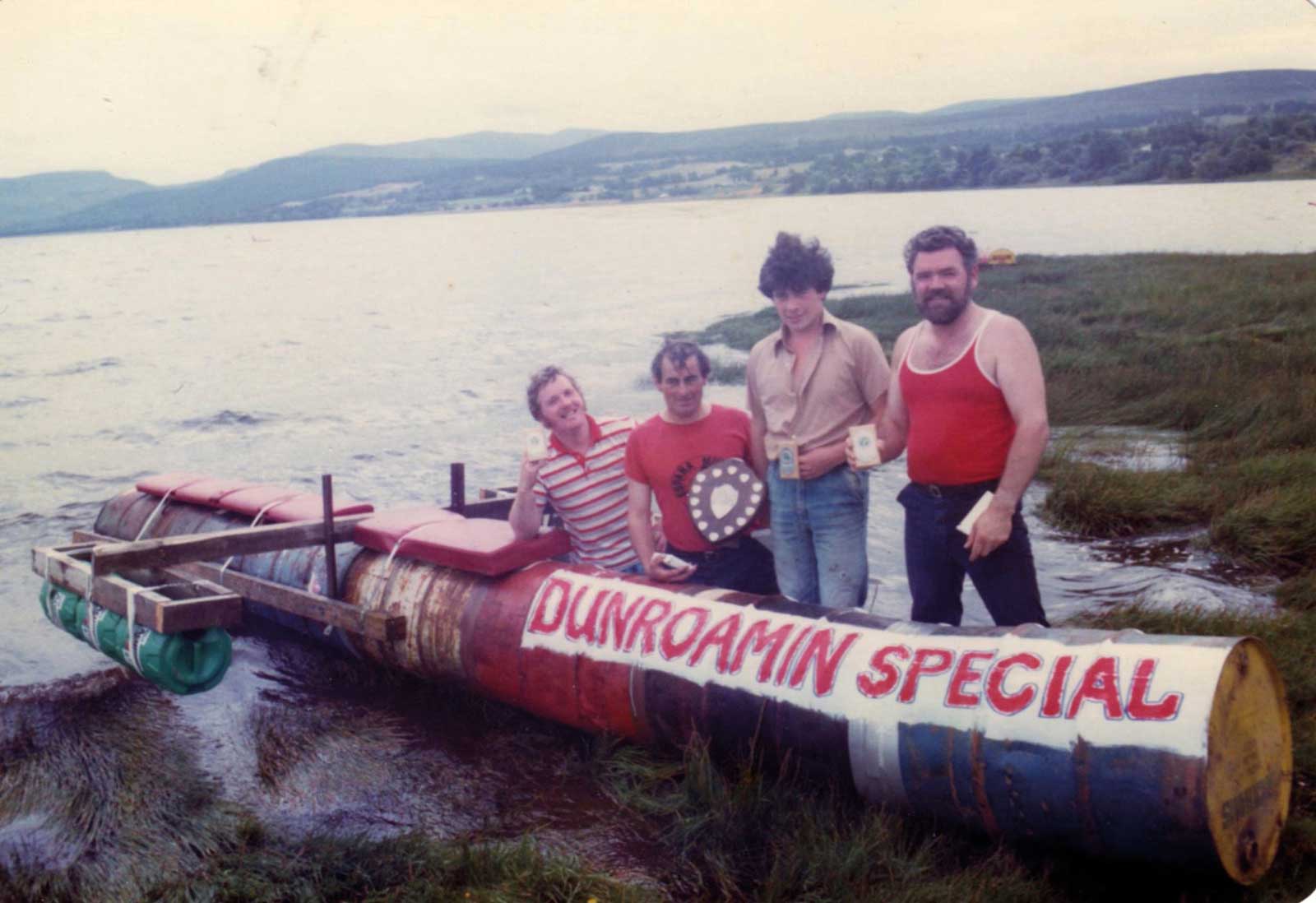
Various images of the Kenny's Games at Kincardine in 1978, including the raft race and its winners (bottom left). All photos © Gregor Laing.
In 1980, Kenny’s Games moved to a field owned by Mr Munro, Invercharron Mains, Ardgay. It was just south of Bonar Bridge, on the seaward side of the old A9 road. In addition to the more traditional Highland Games events, Terrier, Lurcher and Whippet dog racing also took place, and Cumberland Wrestling was also new to the busy programme.
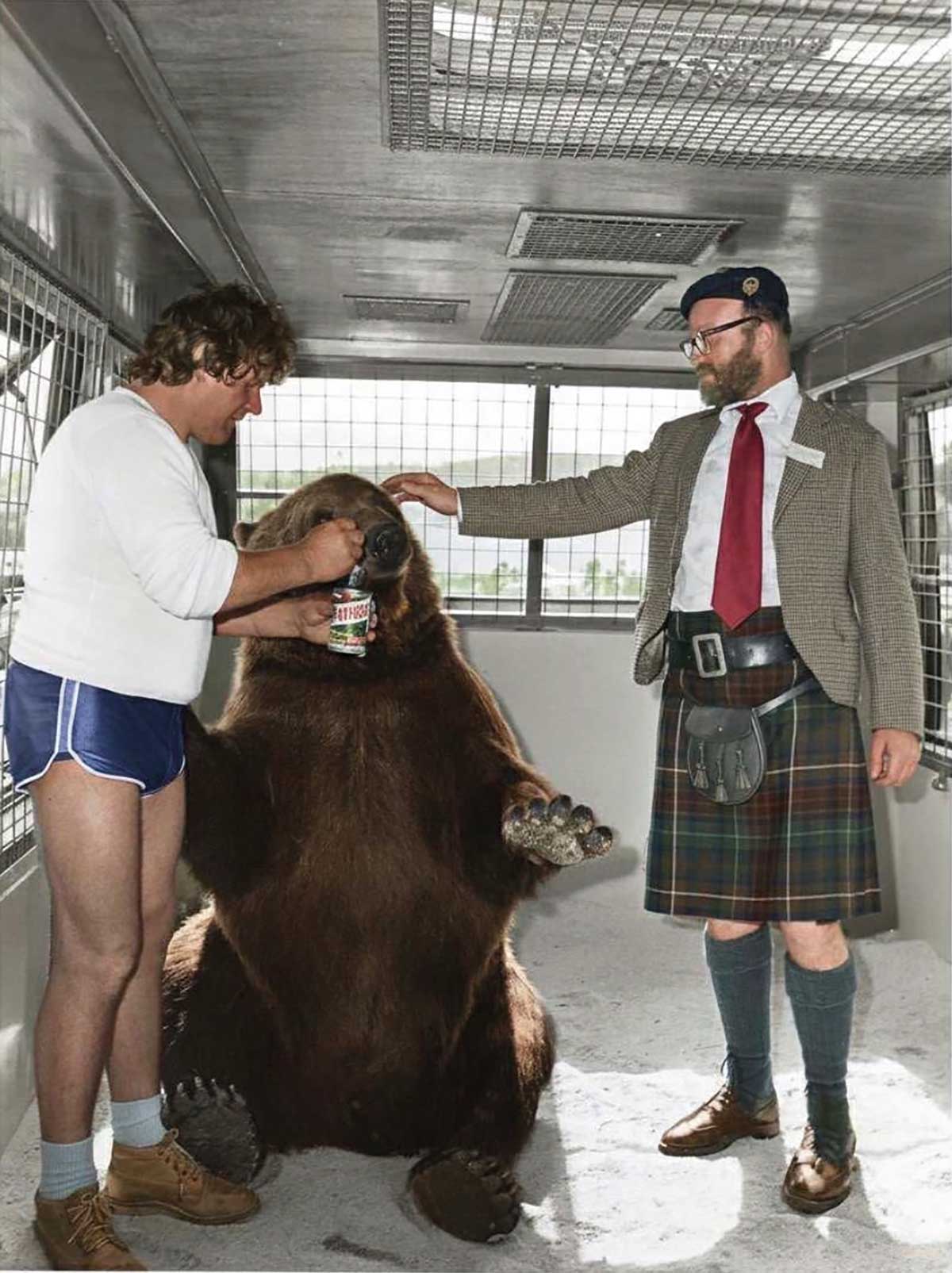
In 1981, “Kenny’s Games” moved across the A9 road, into a field on Poplars Farm. New to the programme was a raft race. However, the star attraction was the appearance of the Big Softy, Hercules the Bear. Many readers will remember that in 1980, while Hercules was being filmed for an Andrex advert on North Uist, he escaped and went on the run for three weeks.
In 1982, traditional Highland Games type events were still competed for on Poplars Farm. The ‘novelty’ events now included Target Golf, a Woman’s 5 a-side Football competition and a Dog Show.
In 1983, the 6th Kenny’s Games moved to Invershin Farm, where the normal full programme of traditional and novelty events were continued. These were the first known Highland Games to be held in Invershin.
In 1985, the extensive programme at Invershin Farm included a full list of Track and Field events, Piping, Highland Dancing, Junior Cycling, Cumberland Wrestling, Children’s Races, Tug-of-War (Open, Ladies, 104 stone, Novice, 5 a-side Barefoot and Novelty), Piano Racing, Children’s Tricycle Race, Target Golf, Nail Driving, a Dog Show, Dog Racing and a Hill Race. However, the Star Attraction, was the return of Andy Robins and Hercules the Wrestling Bear.
In 1989, the 12th consecutive and indeed the final Kenny’s Games, were held at Invershin Farm. All the former events took place and as usual, all monies raised were donated to Cancer Research. There was a chainsaw challenge added to the programme, when spectators had to guess how long it would take for Kenny’s wife Julia, to saw through 50 six-inch blocks of wood. The task was completed in less than 2 minutes 45 seconds. Afterwards, a new committee was formed but unfortunately, no further Kenny’s Games were ever held.
Invercharron Highland Games
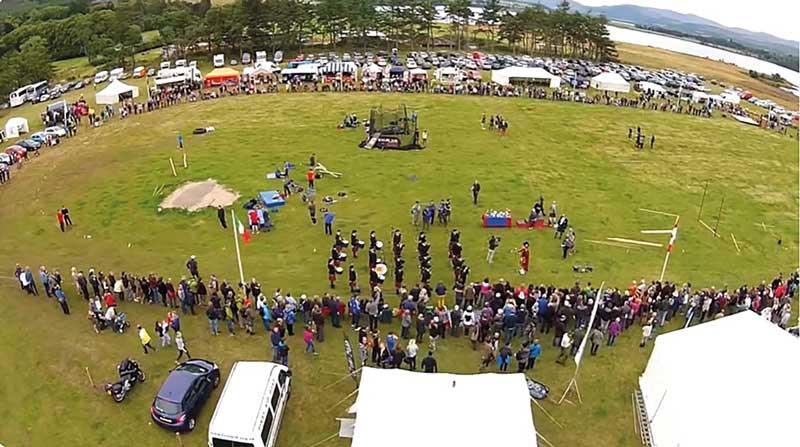
On 19th September 1981, the Invercharron Highland Games, which had last been held some 79 years earlier in 1902, were revived. The Games were held at South Bonar, in one of Mr Munro’s fields, on the shore side of the old A9 road. The Chieftain was Lord Bruce, the Earl of Elgin. The President of the new Committee was Murray Macleod, the Vice President was Ian Brinklow, the Secretary was Morag Chalmers, and the Treasurer was Ronald Cameron. The Heavy Events were: 16lb Shot, 22lb Shot, 56lb Weight over the Bar, 16lb Hammer, 22lb Hammer and Caber. The Track & Field events were 100 yds, 400 yds, 800 yds and 1600 yds. The Light Field events were, High Jump, Long Jump, Hop, Step and Jump and Pole Vault. The Cycling events were 800 yds, 1600 yds and 3200 yds. There were also Piping and Highland Dancing events, with Tug-of-War competitions ending the day. Among the prize winners were Bill Anderson and Hamish Davidson.
In 1982, the venue for the Games moved across the A9 Road, to a field at Poplars Farm. Unfortunately, on the day it rained, and it rained, and it rained... with the Arctic-like conditions making the area a quagmire. So much so that some people questioned why the Invercharron Games were being held so late in the season. As the fledgling games were members of the Scottish Games Association (SGA), they had been awarded their prestigious 104-stone Tug-of-War Championship, which was won by a team from Elgin. Fly Casting and Dog Racing were added to the previous year’s programme.
In 1983, the Games returned to the field on the seaward side of the A9 Road, never returning to the Poplars Farm site. The committee realised that holding their Games so late was prone to bad weather, but as it was the last Games in the season, it brought many good competitors who were chasing league points across all disciplines. Thankfully there was some sunshine, albeit with a few rain showers.
In 1984, an innovative Young Heavies competition was introduced, which featured a large number of up-and-coming stars. Whippet racing also started. In the following years, clay pigeon shooting became popular.
In 1989, due to expectations of a unusually high tide of four and a half metres at 1.30pm, a decision was made to move the Games to Balblair Farm. The field was kindly put at the disposal of the Games Association by Mr Peter Campbell. Despite the move, there were more competitors and spectators than usual, with a large contingent of foreign visitors.
In 1990, the Games returned to its field at South Bonar. A record crowd of people attended the Games, no doubt helped by the Indian summer-like conditions.
In 1991, the weather conditions were similar to 1982. Rain and gale force winds were blamed for a much lower attendance. A tarpaulin was lifted off a trade stand, and a tent was blown down. Despite this, the committee decided to continue with the Games. Thankfully, things improved during the afternoon and the programme of events was completed.
In 1992, misty conditions prevailed, with a shower of rain in the afternoon. Three television crews from Australia, Germany and Grampian TV filmed the Games.
In 1993, due to expected high tides, the Games were once more moved to Balblair Farm. Juvenile Track and Field events were added to the programme for the first time. Ten Tug-of-War teams competed for the three different pulling categories. A Belgian TV crew spent the day filming on behalf of a “Jim’ll Fix It” type programme.
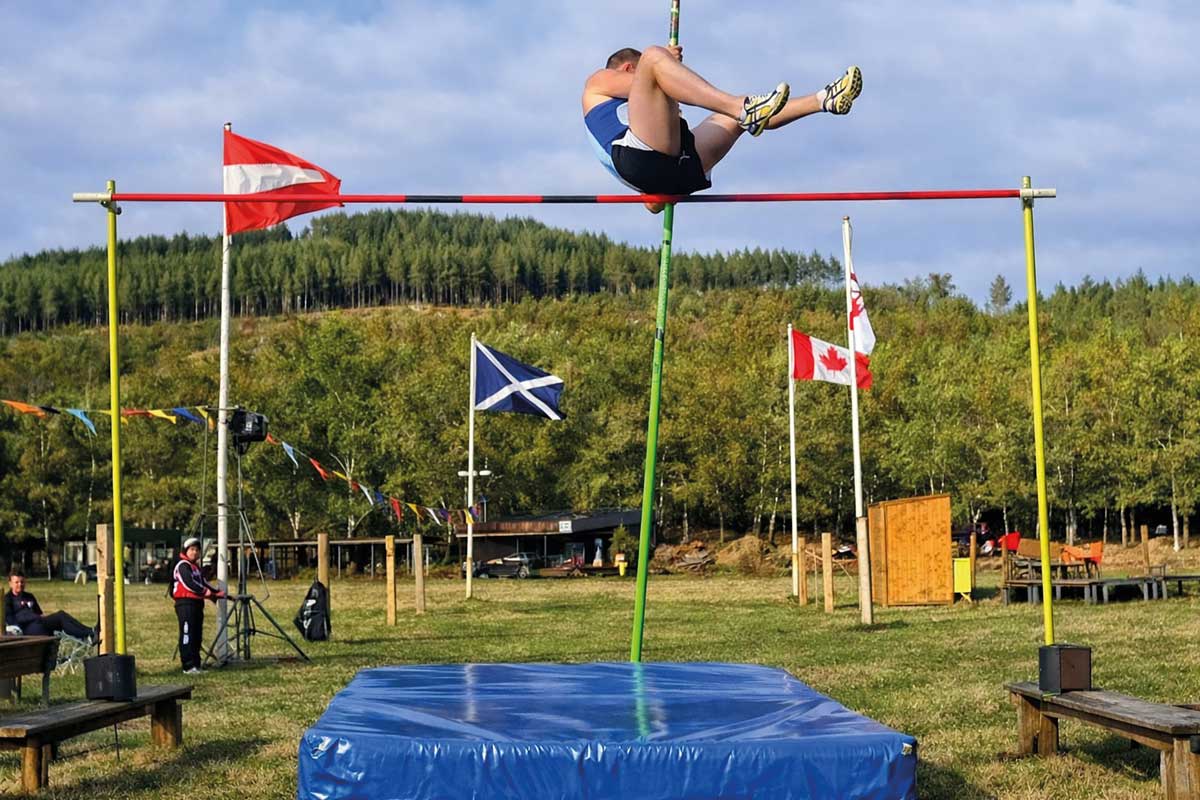
In 1994, the Invercharron Games appointed a female to be their Chieftain for the first time, Miss Nancy Nicolson, a journalist and BBC Radio broadcaster. Such was the popularity of the three different categories in the Tug-of-War competitions, that two ropes were required to finish the competitions on time, and an extra platform was needed for the piping competitions.
In 1996, with the Games held at Balblair, a Hill Race took place for the first time, sponsored by the previous year’s Chieftain, accordionist Phil Cunningham, and fellow violinist Aly Bain. The venue for the following year’s games was in doubt, as Mr Campbell was contemplating cultivating the field which had lain fallow for the past three years.
In 1997, the Games moved across the A836 road to the seaward side of Balblair Farm. Though generally flat, the new venue was described as uneven and a bit tufty. Included in the field was ample space for parking. The Chieftain was Fiona Kennedy. After the Games, she held a concert in the Ardgay Hall.
In 2000, the attendance was affected by the country-wide demonstrations against the petrol tax. One “casualty” was the Highland Dancing judge from Edinburgh, who called off. In 2001, due to restrictions resulting from a flare-up of Foot and Mouth Disease in Northumberland, the Invercharron Games Committee made a unanimous decision to adopt a “safety first” approach and cancelled their annual “revived” Games, for the first time.
In 2002, the ramifications following the Foot and Mouth Disease brought further problems for the Invercharron Games. Agricultural restrictions prevented the Games from being held at its normal field at Balblair, where livestock had recently grazed. Stepping up to the mark by providing a suitable field, were the secretary’s (Morag Chalmers) daughter, Deirdre and Marshall Selkirk, who kindly offered their field at Airdens, some two miles north of Bonar Bridge, eligible to host the event. The 300-yard track proved a testing “obstacle course” for cyclists and athletes, as it was more suited for a cross-country race. It was rough and carried an embedded stone or two, against which spikes grounded and about 100 yards from the finishing line there was a hill. However, all the competitors had to share the conditions, effectively making it a level playing field.
In 2003 the Games returned to the seaward side of Balblair Farm.
The games on TV
The Invercharron Games continued to be successfully held on the same Balblair field for the next few years. They were given national recognition in 2010, when the BBC Master Chef programme crew attended and filmed throughout the day. They prepared a lunch for 100 hungry attendees. The episode was screened on March 2011, in Series 7, Episode 5.
In 2012, due to stormy weather, the Games were cancelled for the second time, though some events did go ahead, at the nearby Invershin Hotel. Three tents had been destroyed by the windy conditions, forcing the cancellation. In the following three years, the Games returned to the normal field at Balblair.
In 2014, a Swiss SRF TV film crew attended the Games, their film is available on the Invercharron Highland Games Youtube channel.
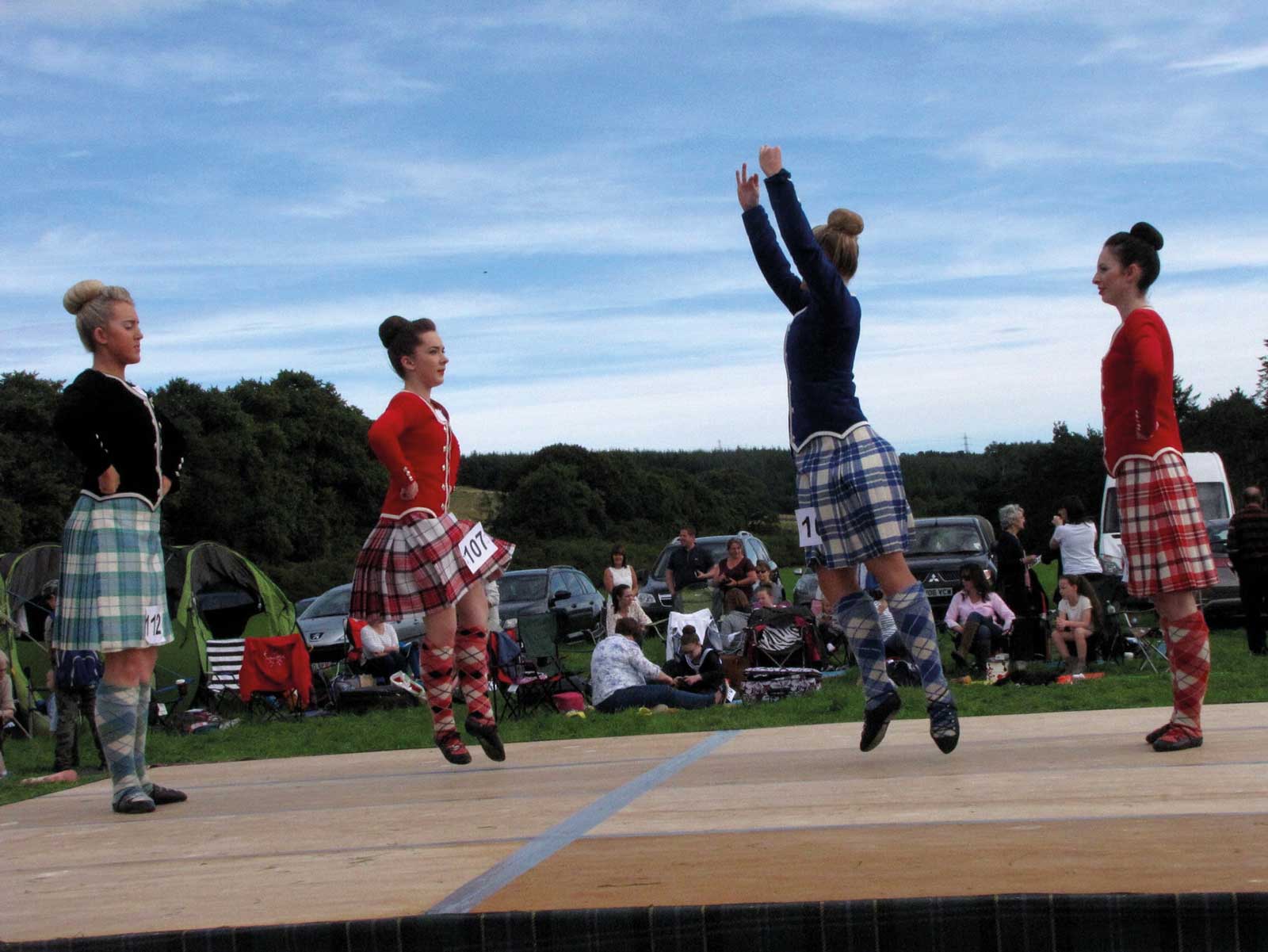
In 2016, the usual field at Balblair Farm was unavailable, as it had been leased to the Deloitte Ride Across Britain cyclists. However, the adjacent wood field proved to be a good substitute. The weather stayed fine and a successful Games were held.
In 2017, the 36th ‘revived’ Invercharron Games were again held in the Balblair wood field, as the cyclists were using the ‘normal’ field. There was a full programme of events, including events for Novice and Open Heavies, Track and Field events for Juniors and Seniors, Cycling Races, Highland Dancing, Piping, Tug-of-War competitions and Hill Races. Unfortunately, the weather conditions deteriorated to such an extent that entrance and exit from the field became a quagmire. This proved to be the last Invercharron Games.
In 2018, the Games were scheduled to be held on 15th September, but once again, the weather had different ideas. Unlike former years, good, or arguably, too good weather was to blame. The event had been cancelled with “severe regret” because of the “exceptionally dry weather”. It explained that the grass crop could not be harvested, as it had been slow growing as a result of the hot conditions. No other field could be used.
Due to a shortage of willing committee members and difficulties in identifying any other suitable venue, the Invercharron Games has now fallen into abeyance.
Last games of the season
The Invercharron Games will be remembered as being the last Games in the Highland Games season. Being held so late (the 3rd Saturday in September), the weather was always going to be a problem. Higher than normal tides also caused problems, especially at the original site. A lack of suitable venues also caused problems, as over the 36 years of ‘revived’ Games, six different fields were used, with nine annual changes made. Not one of them being held at the original Games field, at Invercharron House. One of the memorable events that took place prior to the opening of all the Invercharron Games, was the ‘Beating of the Targe’. The Chieftain would hit a wooden targe (leather covered wooden shield), with a claymore, while facing the four cardinal points of the compass, to the North, to the East, to the South and to the West. Simultaneously, the starter would fire his pistol, thus summoning everyone to the games, and officially opening the proceedings.
List of Invercharron Highland Games Chieftains
Over the years, the Invercharron Games Committee asked local dignitaries or other celebrities to be their annual Chieftain. Over the 36 years, the following were the Chieftains :
1981 – Lord Bruce
1982 – Sir John Brooke
1983 – Charlie Allan
1984 – Andy Ross
1985 – Col. Sir Allan Gilmour
1986 – Colin Campbell
1987 – Andy Stewart
1988 – John Stahl
1989 – Ellice MacDonald CBE
1990 – Bill McCue OBE
1991 – John Matheson (Prof)
1992 – Jesse Rae
1993 – Alasdair Gillies
1994 – Nancy Nicolson
1995 – Phil Cunningham
1996 – Stephen Robertson
1997 – Fiona Kennedy
1998 – Norman Maclean
1999 – Ian Brinklow
2000 – Lesley Riddoch
2002 – Charlie Simpson
2003 – Martin Ramsay
2004 – Peter Campbell
2005 – Cllr Mrs Alison Magee
2006 – Angus McLaren
2007 – Nicola McAlley
2008 – Peter Crome
2009 – Mark Stephen
2010 – Raymond More
2011 – Bruce MacGregor
2012 – Games called off
2013 – Dr Mary Fortune, Brora
2014 – Councillor Deirdre Mackay
2015 – Rev. Susan Brown
2016 – Val McDermid
2017 – Jimmy Yuill
2018 – Helen Houston – though appointed, the Games were not held.
By Alasdair MacDonald, Historian for the Royal Scottish Highland Games Association
Comments ()