

Shrews, life in the fast lane
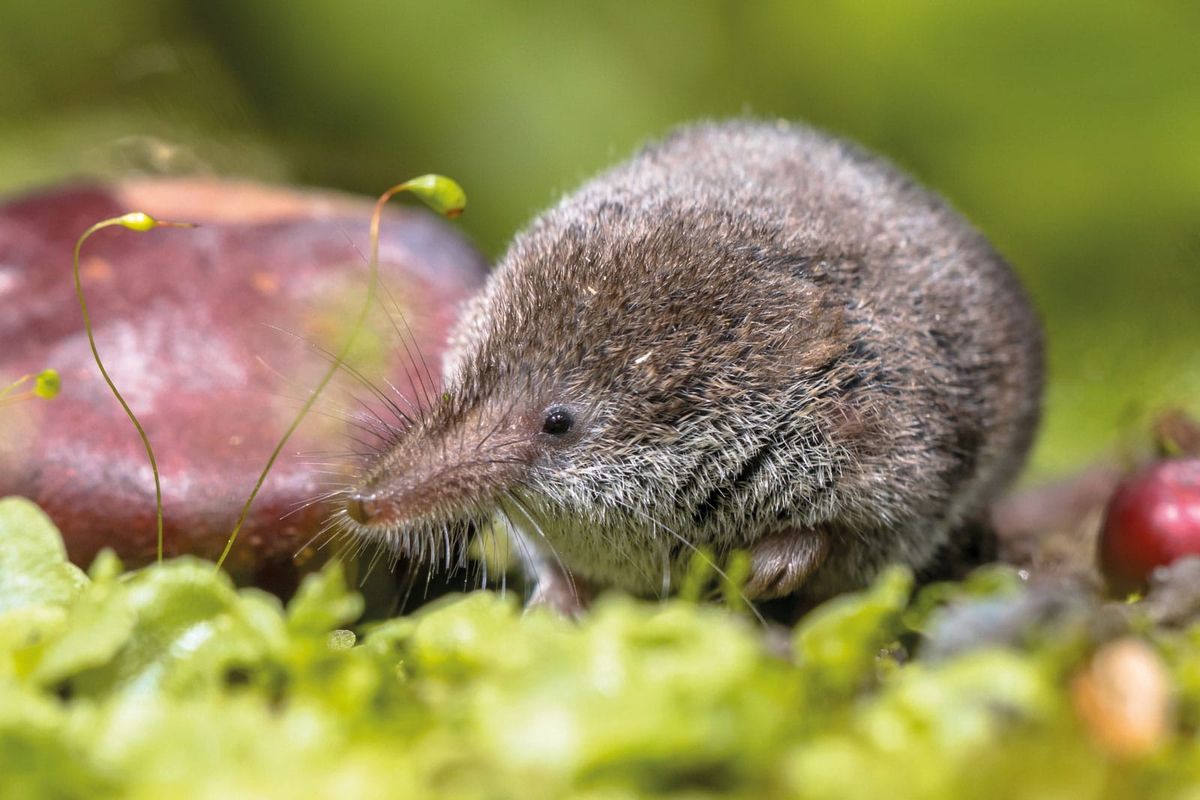
Scotland’s smallest mammal eats hundreds of small invertebrates a day to survive.
By Cherry Alexander
I have always thought that all the small fluffy mammals in my garden are rodents, mice, rats, voles and shrews. The definition of a rodent is that their teeth keep growing throughout their life, but the shrew is different. It is from an order called Eulipotyphla, which includes moles and hedgehogs, and it’s tiny teeth are tipped with brown, said to be iron which strengthens them.
Shrews are also different because they live life in the fast lane, with a heartbeat of around 500- 1,000 beats a minute, (human heartbeats are 60-100 per minute) and a lifespan of just over a year, these tiny, long nosed predators have to eat 125% to 200% of their body weight every day, or around 250 insects, to keep from starving. So they sleep in short bursts and then start hunting again, day and night, or they starve to death. In winter they don’t hibernate, but they shrink; they shrink their bones and even their skulls and brains, as a smaller animal needs fewer calories to sustain itself when food is very scarce. This is known as Dehnel’s Phenomenon. In spring they regrow all the body mass lost over the winter.
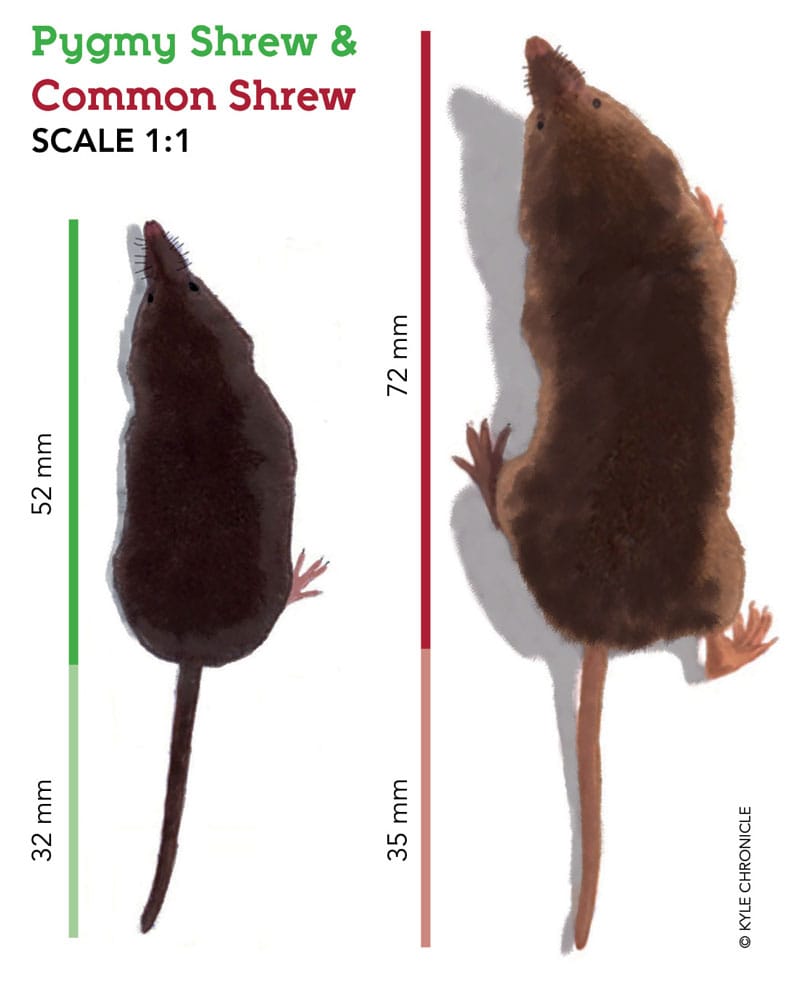
There are three species of shrew in Scotland. The rare and larger water shrew (Neomys Fodiens) that lives close to water and has poisonous saliva that it uses to immobilise frogs and small fish. Locally we have the common shrew (Sorex araneus) and the pygmy shrew (Sorex minutus).
If you hear a high pitched squeal in your garden it is likely to be a highly territorial shrew defending its territory, or its latest meal. In the long grass of my wildflower meadow, I have a few pygmy shrews, I mostly only see them when one dashes across a path, or if the dogs catch one. Shrews have an unpleasant taste, so my dogs will not eat them, preferring to roll on them, but it is a shame that they catch them at all. It seems that winged hunters like owls and kestrels are less discerning than my dogs, and they are the main predators of shrews. It is illegal to trap or kill shrews under the Wildlife and Countryside Act 1981.
The home range of the pygmy shrew depends on the habitat but the maximum is 12 shrews to a hectare. Their territoriality is only suspended during the breeding season, Unlike the common shrew, the pygmy shrew has 2-3 litters a year, usually of about six young. Britain’s smallest mammal, the pygmy shrew is 40-60 mm; of which the tail is 32-46mm, weight 2.4-6.1g. Their weight may decrease up to 28% in winter. Their diet mostly comprises insects, woodlice and beetles, but there are invertebrates in the garden that are too large for the pygmy shrew to manage to eat. This tiny shrew is two-tone, with brownish grey fur on the back and a grey belly. With small ears and very small eyes, the pygmy shrew depends mostly on its sense of smell, hearing and sensitive whiskers on its long nose. The pygmy shrew is the most ancient species of European shrew, with a fossil record dating back as far as the Pliocene, 5.3 million years ago. It’s also the most widespread, ranging across most of Europe, but it only found its way into Britain at the end of the last Ice Age.
Common shrews are slightly larger with a darker brown velvety coat and a pale underside. Unlike the pygmy shrews, they breed three to four times a year, having around 6 shrewlets each time. Mainly they feed on insects but also earthworms, spiders, and small slugs and snails. They weigh 5-14g. Length: 5-8cm, tail: 2-4cm. Their tail is shorter in proportion to their body compared to the pygmy shrew. They live slightly longer than the pygmy shrew at 1-2 years. Common shrews are notable for families forming a Caravan. This is a family of shrews following their mother, holding each other at the base of the tail of the shrew in front, usually undertaken because their nest has been disturbed.
Shrews are the unseen power converting soil invertebrates into energy for owls, kestrels and other predators. We can help these tiny, speedy beasts by being careful not to disturb log piles or piles of decaying vegetation during the winter months. Not only are these the winter hideouts of our garden insects, they are the shrew’s larder and hunting ground. When you live life in the fast lane, that level of disruption can mean starvation.

Comments ()