

Roe Deer
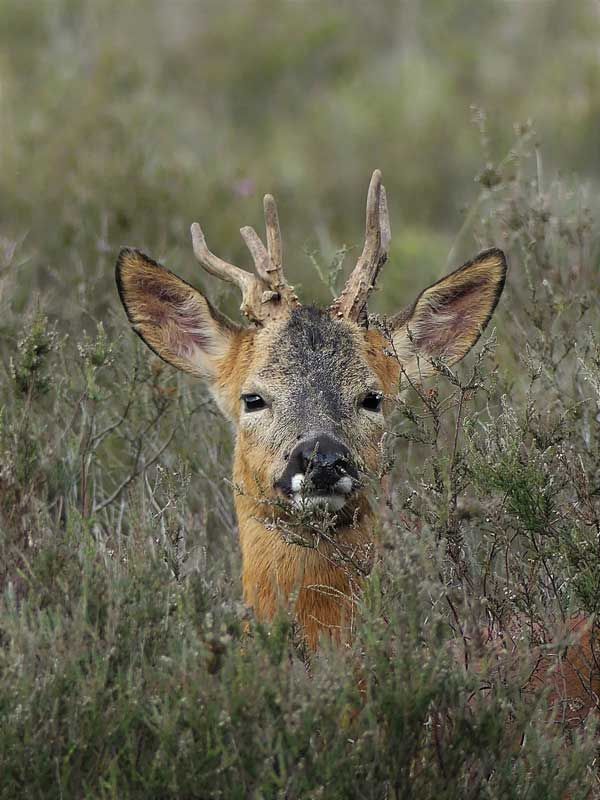
Roe deer, Scotland’s most common native deer, are found across the mainland in a wide range of habitats. They can be seen year-round, though they are most active at dawn and dusk.
By Cherry Alexander
Before we started to build our house, when the garden was unfenced from the small wood, I would often disturb small deer, laying up amongst the broom and long grasses. These were roe deer. Capreolus capreolus, derived from capra, meaning billy goat. Roe deer are dainty creatures and leave small hoof prints (slots) about 4cm long in soft ground. Both sexes have a prominent white rump with no visible tail. Their winter coat is a greyish brown that moults out in summer to a rich chestnut red. They have black eyes and noses. Standing between 0.60m and 0.75m at the shoulder they can weigh between 10-25Kg.
In common with most deer except reindeer, only the buck has antlers, which are shed after the rut every year. They have 3 points when mature and are known as pearled when they have a lumpy texture. They cast them in November to December and their antlers are in velvet from January to March. You will often find evidence in woodland where they have tried to remove the velvet by rubbing their antlers on saplings, shredding the young tree bark in the process.
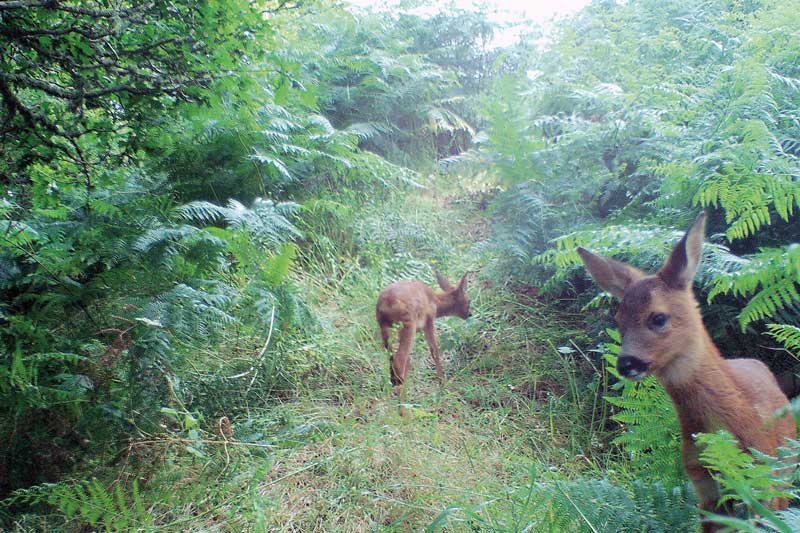
Once I had my wildlife camera in place, about 8 years ago, I was aware that I had a roe doe as a regular visitor to our woodland. Then I got lucky and put the camera at the spot where she would leave her kids, jump the stock fence and go off to feed, leaving the kids safe in the little wood. But this year and last year she hasn’t returned to shelter her young in our wood. Four years ago, in autumn, I found her young male kid dead on the road by the Gearrchoille, he was very distinctive. I hope she has not met a similar fate. It would appear that there are fewer roe than there were 10 years ago, when they kept the regeneration of young trees in the Community Woodland to a minimum with winter browsing. Now the wood is carpeted with young oak and aspen, and they aren’t getting eaten.
If you hit a deer with your car in Scotland, the official advice is to pull over somewhere safe and call the police, perhaps using what3words to give your location. Turn on your hazard lights to alert other road users of the danger. You are advised not to approach the deer in case it injures you. Check that your vehicle does not have damage that would make it unsafe to drive.
Only two species of deer are truly native to the UK, the roe and red deer. Roe deer are found through most of mainland Europe and into Northern Iran and Western Russia. Fossil records date back to 6,000 - 10,000 years BC. Their favoured habitat is woodland edges and adjacent fields. Roe can cause damage to woodland and forestry by browsing. I was told that a favourite food is ash seedlings and certainly there are far fewer seedlings in our wood, where the roe have access, than in the garden where they do not.
The rut takes place from mid July to mid August, but the fertilised eggs do not implant until January, there is a gestation period of 290 days. Kids are born between May and July; one or two, usually a male and a female, with spots on their baby coats. Roe does hide their kids while they go off and eat alone, but will return and feed them several times a day, the kids have little scent and are safer from predators than if they try to keep up with their mother. If you find young deer concealed in the undergrowth, do not assume that they have been abandoned. Their mother will return to them, but not until you have moved away. Do not touch the deer or pick it up and keep any dogs under close control on a lead.
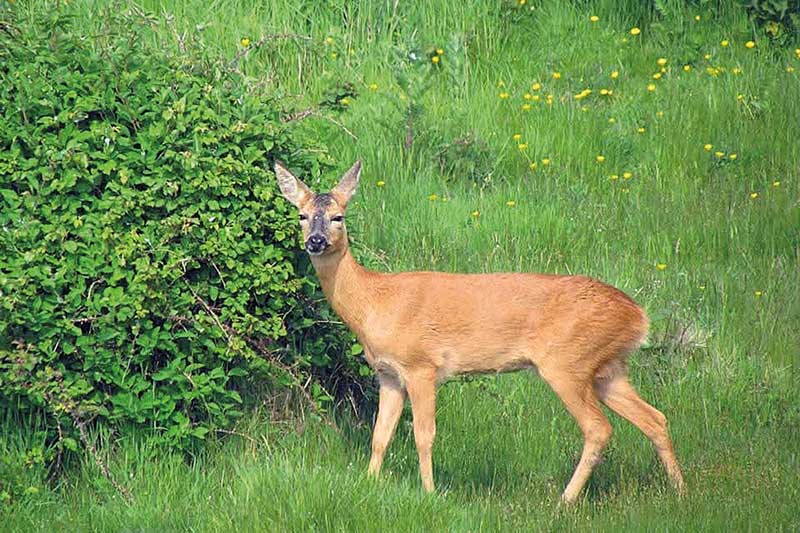
Roe deer are secretive and can hide in the tiniest bits of cover. I now rarely see them on my dog walks, but I am sure that they are seeing me. Time was when none of the local spaniels chased deer, then I would see roe regularly, and could pass fairly close to them, even in the Gearrchoille. I think that they know the people they see regularly, but are less sure of the dogs. Some of the local roes had a pale band of fur running around their necks, so were easy to identify. Now I have to stop and look carefully into the woodland for the tell tale flick of an ear or a white rump. They are usually solitary or in small family groups.
The Roe Deer shooting season: now is bucks: year-round (Previously, April 1st to October 20th) according to Country Sport Scotland, with does: October 21st to March 31st.
I hope that one day a roe doe will again choose to hide her young in our woodland, and that fewer roe are killed on our roads.
Comments ()