

Estuary mud
Cherry Alexander looks at estuary mud and the array of creatures it sustains
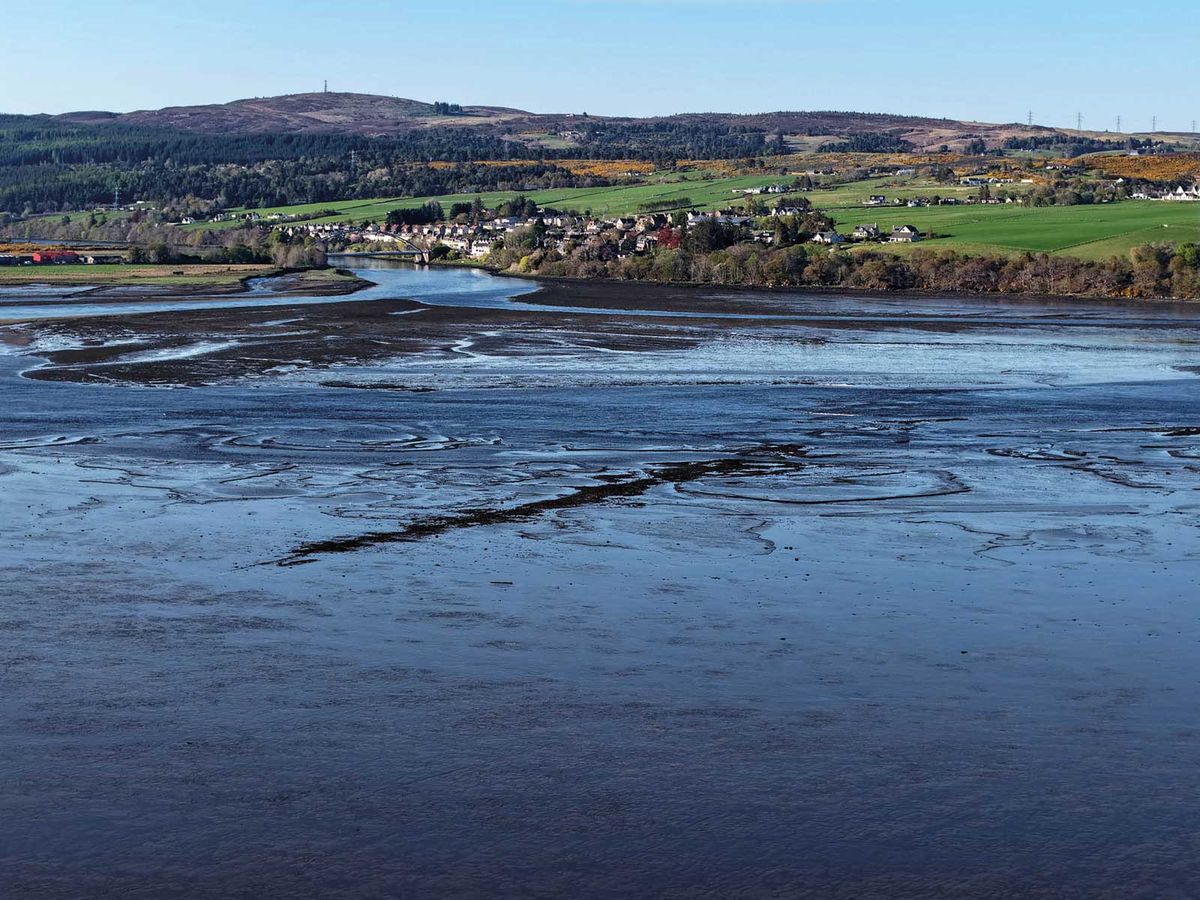
Could we learn to love our mud as much as an oystercatcher does?
By Cherry Alexander
Here, around the Kyle of Sutherland and upper Dornoch Firth, we have a wealth of mud, visible every time the tide falls. It is easy to dismiss this large expanse of greyish brown as dead and uninteresting, but it isn’t. It is so mucky to walk about in that it is rarely disturbed, wildlife can go about their business at low tide without someone walking a dog near them, or pitching a tent.
Our estuary mud is formed where slow-flowing water from both rivers and seawater enter the broad, flat bays of the Kyle and drop their sediments, forming layers of sticky mud. Twice a day the tide comes in and submerges everything below the high tide mark, twice a day the water retreats, exposing the intertidal mud. Nutrients are trapped in the layers and these are energy-rich, supporting an extensive food web. Plants find it hard to establish in this constantly changing environment.
When high tide is reached, and the water slowly retreats across the mud, running out to sea, until all that remains of it is in the permanent channels, as it leaves, the creatures that need to live in water retreat with it, fishes, and crabs. But some creatures are happy to call this home. They need to be well adapted, and mostly they spend the hours they are exposed to the air, taking shelter below the surface of the mud. Our muddy estuaries are often referred to as Burrowed Mud, because of the abundance of burrowing creatures that live in them.
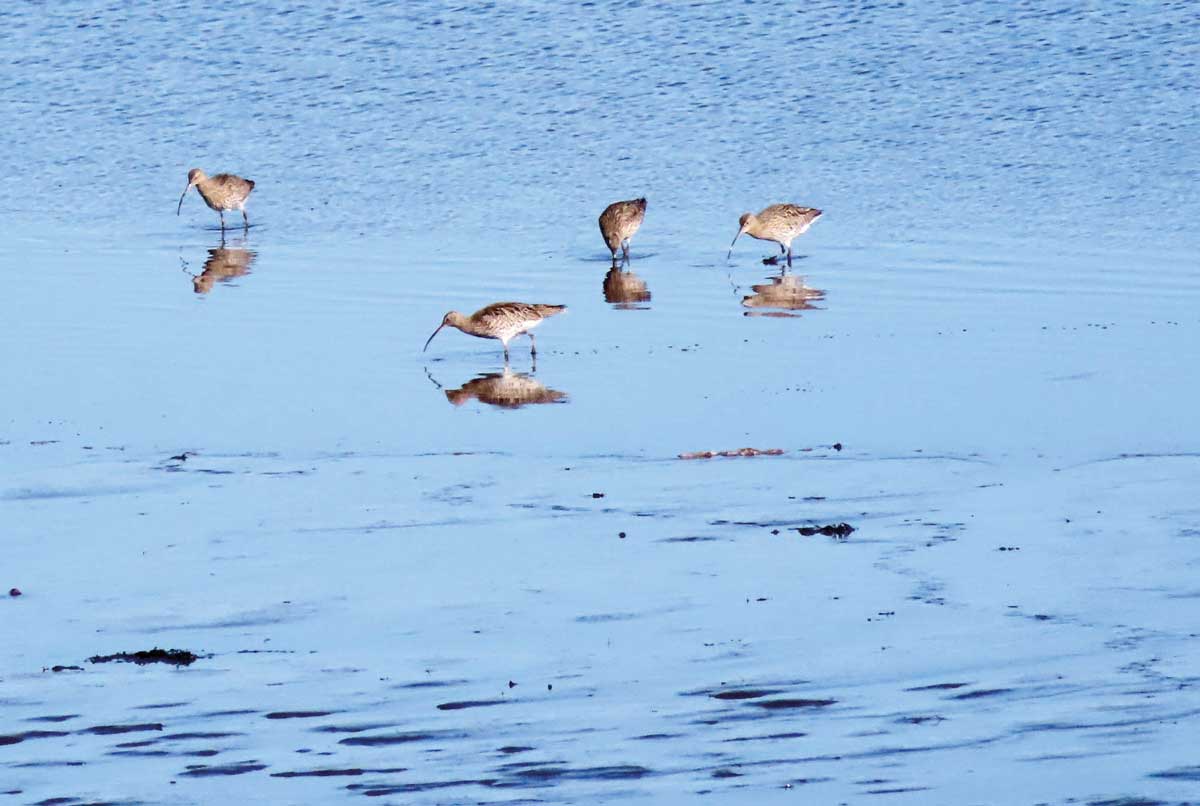
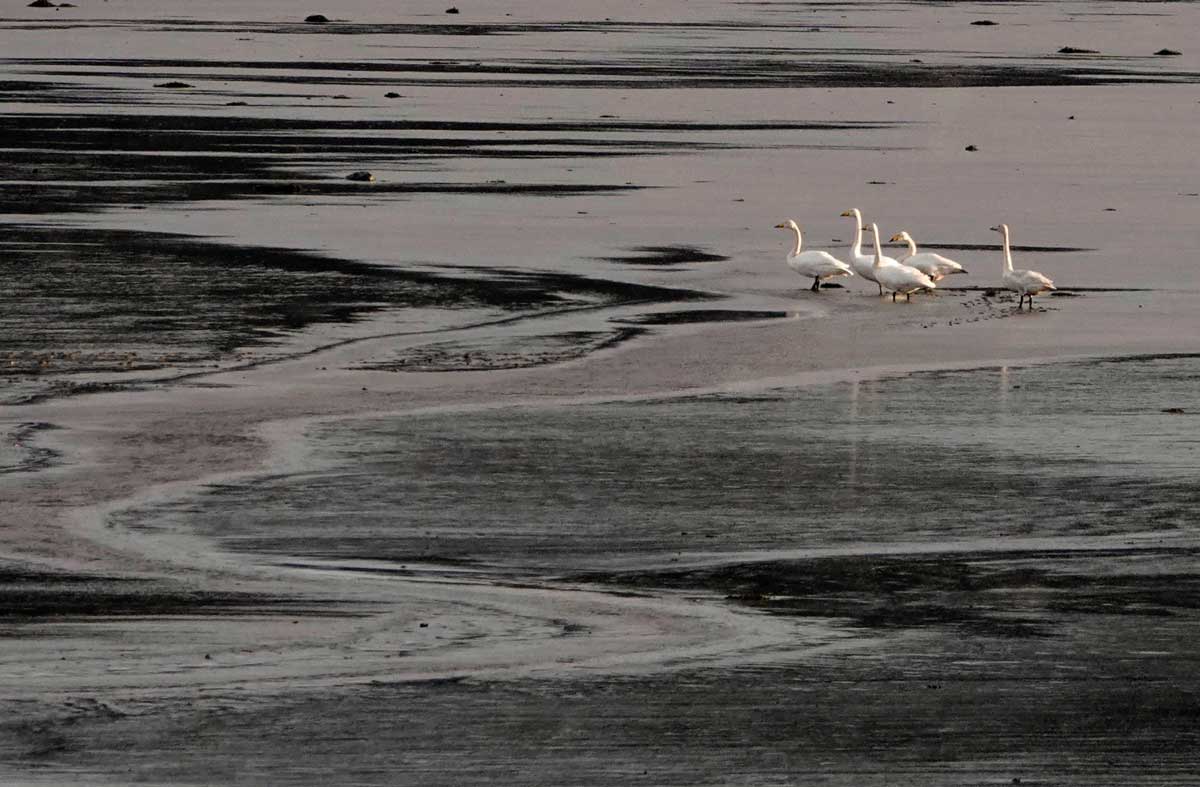
(Left) A group of curlews feed in shallow water over mud, Kyle of Sutherland. (Right) Whooper swans on the mud at low tide. © Cherry Alexander
These creatures include worms, crabs, shrimps, brittlestars and various molluscs and tiny snails. I had heard that estuary mud has a high calorie content but was astonished to read that one cubic metre of estuary mud has the same calorific value as 16 Mars Bars. The cynic in me at once wondered if this was a Mars Bar before or after shrinkflation. (Shrinkflation is the practice of reducing a product’s size, weight, or quantity while keeping its retail price the same.) It seems that in the 1990’s a Mars Bar weighed 65g, until recently it was 51g but is now 40g. I decided to go with the calorific value of a 2025 bar which had a value of 228-245 calories, taking a median of 235, that is around a whopping 3,760 calories for every cubic metre of intertidal mud. No wonder we have so many birds feeding on it at low tide.
The different birds that feed on the mud have many methods; curlews have long beaks to probe for deep burrowing worms, the shelduck uses its broad beak to sift the surface mud for small shell fish and snails just below the surface, as do wigeon and teal, small waders like the dunlin pick tiny creatures off the surface of the mud with their shorter beaks, so do gulls.
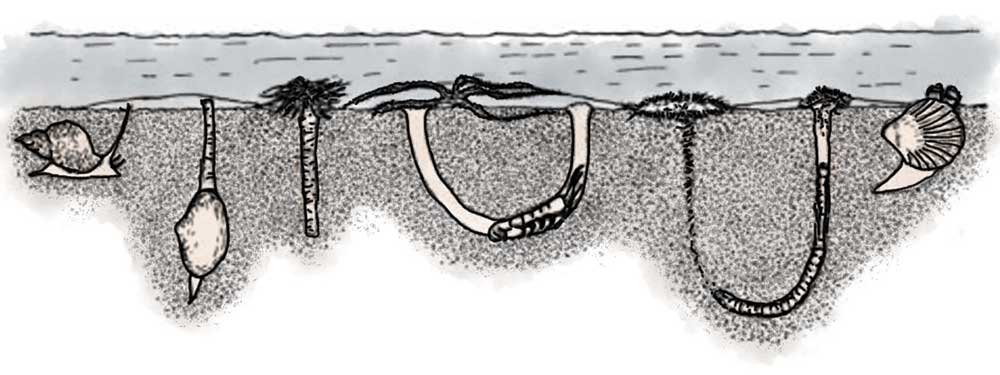
Down to 5cm below the surface you can expect to find mud snails, (Hydrobia acuta neglecta), corophium shrimp (Corophium volutator) and young cockles, (Cerastoderma edule), at 5-15 cm deep there will be lugworms, (Arenicola family), and baltic tellin, (Macoma balthica) deeper than 15cm are the ragworms, (Hediste diversicolor). These creatures all help to aerate the mud which would become anoxic (lacking in oxygen) without them.
The Joint Nature Conservation Committee (JNCC) states that the Dornoch Firth intertidal area is an extensive, high-quality, and largely undeveloped estuary (designated a Special Area of Conservation, SAC ), partly for its intertidal mud flats and the birds that use them.
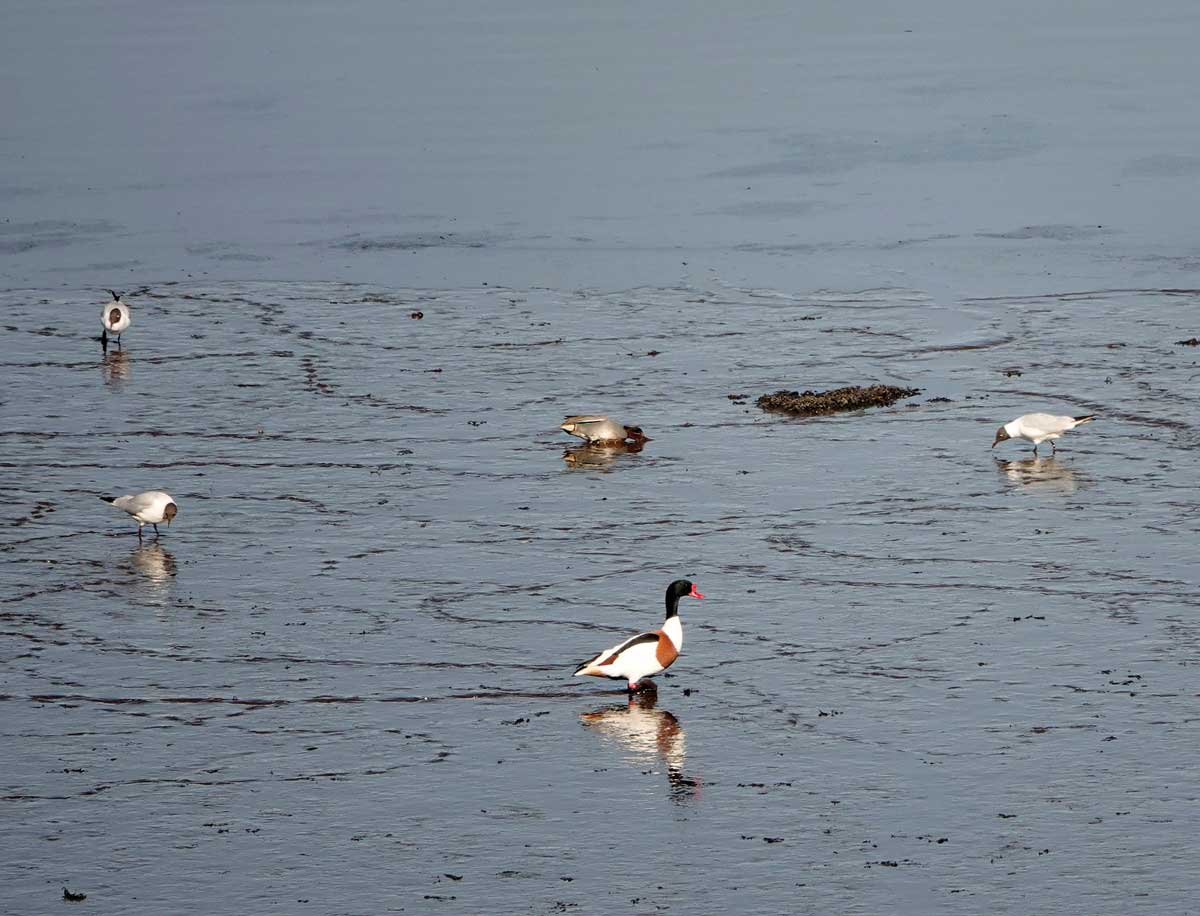
Our garden sits on the South shore of the Firth. When we first viewed the plot, the tide was out and my first thought was that it would be prettier at high tide. Now the high tide is the least interesting time, with only the odd crow or bird of prey checking out the water’s edge. Low tide is when the action happens, and the visitors arrive. Winter is the busiest with flocks of small waders, dunlin, knot and redshank feeding just ahead of the water’s edge. Sometimes we catch sight of the otter running by, or hear the magical call of the curlew or whistles of the wigeon as they chat amongst themselves. Over wintering geese often use the mud for safety when low tide falls at night, I hear them chattering to each other in the dark, in the morning only their footprints remain in the wet mud as witness to their visit. Sometimes whooper swans stop by, but for me, the oystercatcher is the bird that defines the mud of low tide, feeding in the track of the burn across the mud in winter, and flying over calling, in pairs, as spring turns to summer.
As the winter birds disperse to breed in our mountains and moorlands or migrate back to Scandinavia and the Arctic, their place is taken by shelducks that nest in the banks above high water and lead their ducklings out onto the mud to feed every day, black headed gulls patrol the waters edge picking up tasty morsels.
As the tide returns across the mud, creatures that have been hiding under its surface can once again resume their lives in the water, with a different set of predators waiting to eat them. Flounders, other fish and small crabs move back out across the flat bay, now covered in water for a few short hours. In summer the ospreys take advantage of the shallow water to easily see their next meal. We are so fortunate to have this resource in our midst, it is never “just mud”.
Comments ()