
The archaeology of Loch Migdale

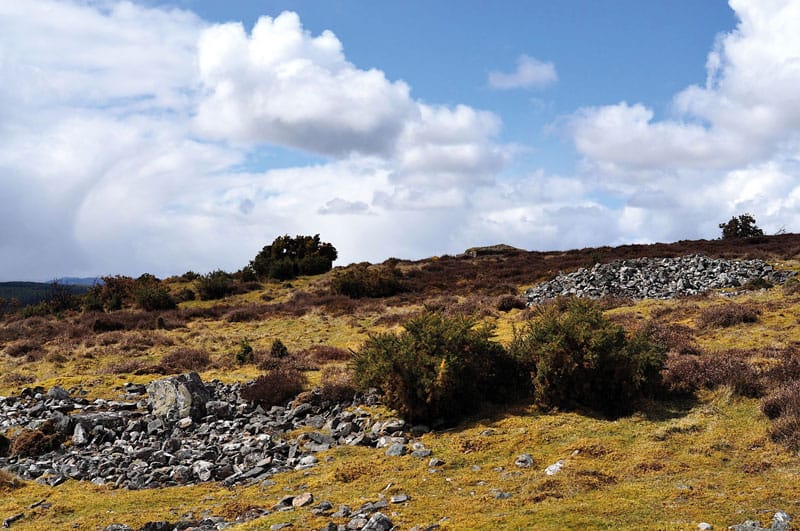
A Bronze Age treasure, an Iron Age crannog, a small henge, a hut circle, cairns... There is evidence of human habitation in the shores of Loch Migdale for more than 4,000 years.
In May 1900, while placing explosives to blast a granite knoll to the west of Loch Migdale, a group of workers found a series of metal artifacts, ornaments and buttons concealed in a crevice on the knoll. The land was part of Skibo estate, and its owner at the time, Mr Andrew Carnegie, who was a fellow of the Society of Antiquaries of Scotland, exhibited the findings the following year.
The Migdale Hoard –as it became known– was a very influential discovery, as some of the objects were exceedingly rare. It was believed initially that the treasure may have belonged to one wealthy individual who tucked it away in time of trouble and never recovered it. Other theories point to a sacrificial offering to the gods.
As reported in the Proceedings of the Society of Antiquaries of Scotland 35 (1901), the hoard consists of “two flat bronze axes; three pairs of plain solid rings or armlets of bronze; a pair of flat ornamented armlets, and a portion of another; a necklace of forty (or thereby) cylindrical beads of thin bronze; one (or probably two) ear pendants of bronze; portions, more or less complete, of four (or possibly five) conical hollow bosses of thin bronze, and six buttons of jet of the usual more or less conical form”.
The objects are all typical from the Bronze Age, and thanks to the carbon dating of a piece of willow found inside one of the beads, we now know it was buried between 2250 and 1950 BC.
The axehead had been coated with tin to enhance its appearance, a technique used by the early metalworkers of north-east Scotland. The armlets, made of solid bronze, were worn in sets of three to resemble spiral armrings, evocating Bavarian fashion of the era. There were two flat bronze bangles or anklets, with mouldings around their exterior and decorated with vertical lines. The collection of buttons is particularly interesting, as one is made of jet, imported from Yorkshire, while the other five are made of local cannel coal. These kind of buttons with V-shaped holes were a widespread early Bronze Age fashion across much of Europe. The rest of the hoard consists of a series of sheet bronze ornaments and beads with wooden cores that may have been part of an elaborate woman’s headdress of central-north European style (Bavaria). The copper used to make these objects was imported from South West Ireland.
The Migdale hoard demonstrates that the elite in north-East Scotland between 2250 and 1950 BC had important contacts across the North Sea