

12 months of stunning views: our 2027 calendar is almost here
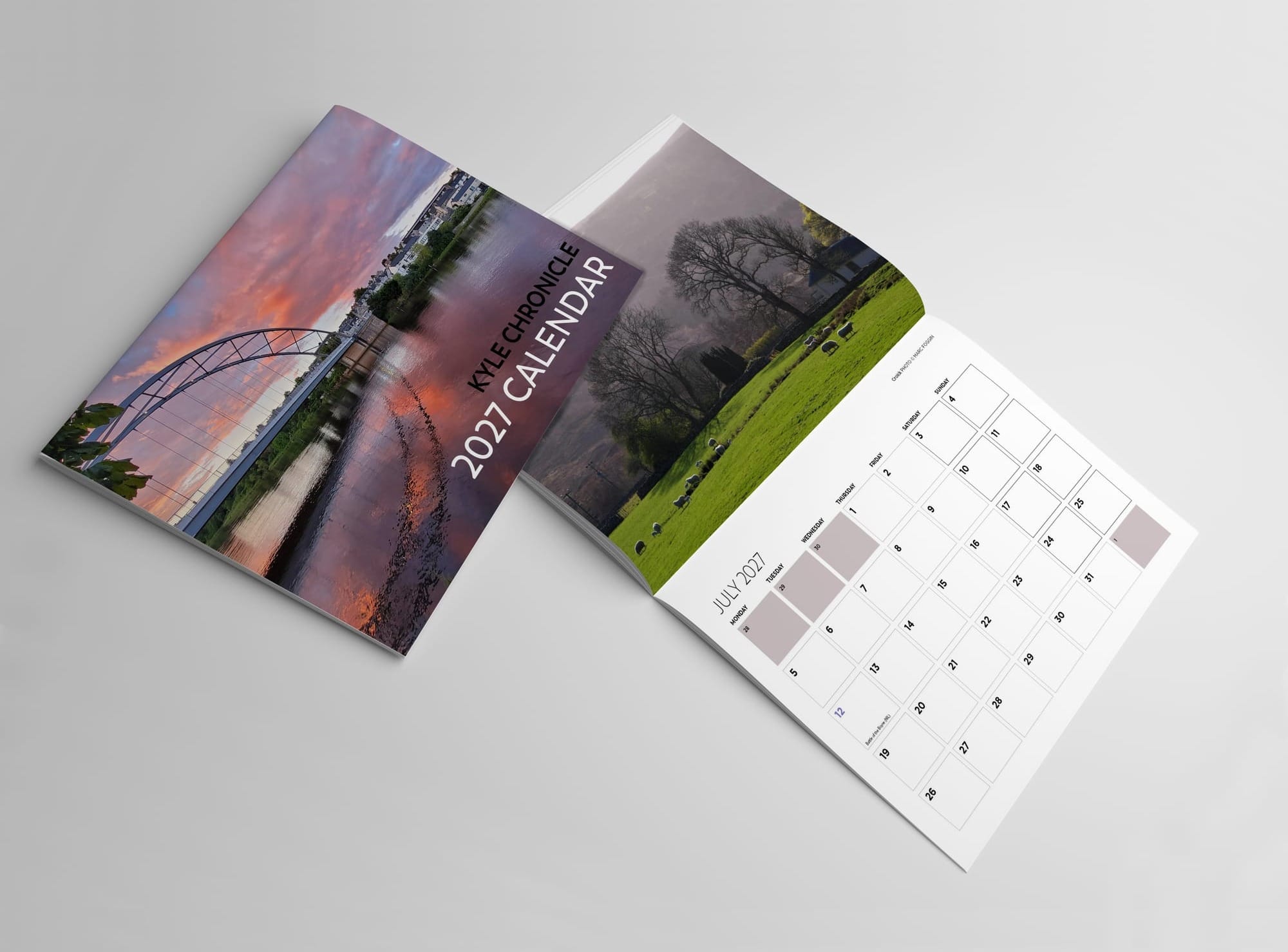
Don't miss out on the Kyle Chronicle 2027 calendar! There are limited copies available, so if you haven't done so yet, please order yours soon.
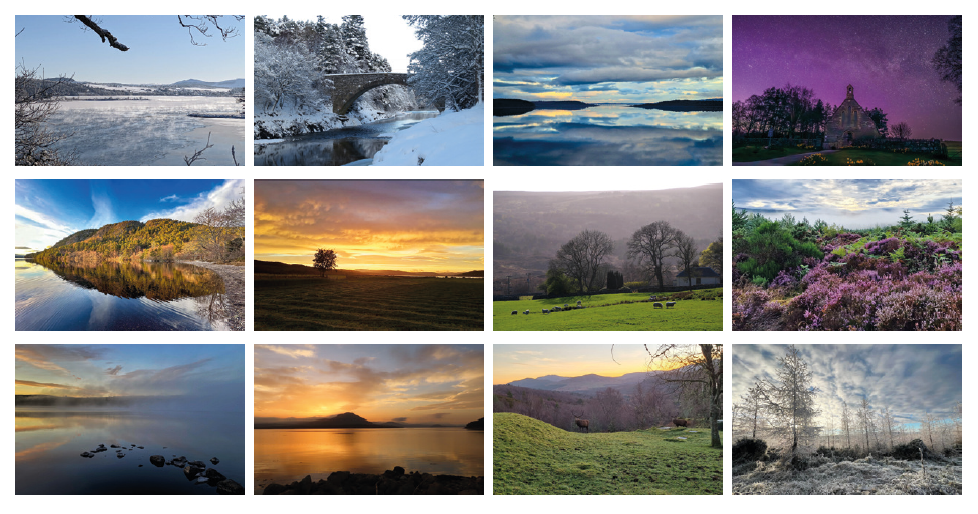
Our calendar reproduces many from the latest Kyle Chronicle "photo of the season" photographs, and more. Printed on high quality glossy paper, the calendar opens in A3, with a hole for wall hanging. Cost £9 (including envelope).
From this weekend, you can collect yours or arrange to have it delivered by contacting Silvia on 07444 299 136 or news@kylechronicle.co.uk. If you wish to receive it by mail a small fee of £2 is collected to cover the postage. And of course, our valued champion subscribers will be receiving it in the post at no extra charge.
All proceeds from the sale of the calendar will be reinvested in the volunteer-run Kyle Chronicle magazine.
A huge thanks to local photographers David Baker, Gill Dunn, Monika Focht, Marc Foggin, Kate Heightman, Anne Henderson, Gregor Laing, Glenys Munro, Darwin smith, Shona Sutherland, and Louise Worthy for their amazing pictures.
All the locations on the pictures have a story to tell:
January: Sea smoke over the Kyle of Sutherland
If the air is still and cold enough (a difference of 10°C or more), great wisps of sea smoke hover and drift above the water surface called sea smoke, frost smoke, or steam fog. The “smoke” is water vapor that forms when cold air moves over relatively warmer water and the thin layer of warm air just above the surface. It’s common in polar regions (where it is called Arctic sea smoke), but it can form over any body of water if conditions are right.
February: Carron Bridge
This 206 year-old bridge, was built by Alexander Thomas Luirson. The inscription on a plaque which is centre on the downstream side reads: "This bridge was erected at the expense of the Second District of Roads in Ross-shire in 1818." This date is unusually earl for a Highland road bridge, reflecting the importance of the area. Its alternative Gaelic name is 'Torran Dubh'.
March: Dornoch Firth
Taken from Spinningdale, looking towards Dornoch Bridge. This bridge, officially opened by the Queen Mother in 1991, was the last of the three bridges erected to improve the A9 north of Inverness. The first two were Cromarty Firth Bridge in 1979 and Kessock Bridge in 1982. The new A9 bypassed Ardgay and Bonar Bridge, bringing a sharp decline in the amount of people driving through these villages.
April: Rosehall Church
In 1900 the majority of the Free Church of Scotland united with the United Free Presbyterian Church to form the United Free Church. As the minority who continued with the Free Church held their building (the much older building on the opposite side if the road) a new church had to be built. This is it, the Rosehall Parish Church of Scotland, built in 1908 and part of the Assynt, Rosehall and Scourie congregation.
May: Migdale Loch reflections
This photo, taken on the shore of Loch Migdale, features Migdale Rock, a granite ‘HuMP’ of 231m (with a drop of 127m). A hill is classified as a HuMP if it is a hill of any height with a drop of at least 100 metres or more on all sides. The name HuMP stands for Hundred Metre Prominence. With 23 climbs and several trails overlooking native woodland and Loch Migdale, the area is a fantastic destination for climbers and hikers.
June: Wester Fearn
Fearn Abbey, founded by Ferchar McTaggart, the Earl of Ross, was originally built in Kincardine at Wester Fearn, some time in the 1220s. The exact location was pointed as “above the high road, in the furthest west field of Ardcronie” (Chronicle of the Ardcronie Children, 1893). In 1238 “with consent of the abbot and brethren of the said place, for the more tranquillity, peace, and quietness thereof” transferred to its current location in the Easter Ross Peninsula, where it was called at first Nova Ferina, New Fearn, then simply Fearn.
July: Croick
Strathcarron - and Croick in particular - is associated with the Clearances; this once well-populated glen is now scattered with the remains of cottages and sheepfolds. The New Statistical Account mentions that in Kincardine parish in the 1810s landlords were “turning several small farms into one, and depopulating whole straths for the purpose of raising sheep.” Strathcarron saw the Glencalvie clearances of 1845, and the violent repression at Gruinards in 1854.
August: Purple heather at Culrain
Bell heather (Erica cinerea) has had various uses in the past including bedding, hatching, tanning, dyeing cloth and even brewing. Written about in verse and song for centuries, it is deeply embedded in Scotland’s culture, meaning homecoming more than most. At weddings it might be given away as favours. It’s also linked with romance, as in the famous folk song by William McPeake, recorded in 1957: “Will ye go, lassie, go, / And we’ll all go together / To pick wild mountain thyme / All around the blooming heather, / Will ye go, lassie, go.”
September: Mist at Loch Migdale
Early morning atmospheric light at the shore of Loch Migdale. Autumn brings mist and magical colours to the landscape. Like a cloak of invisibility, the mythical féth fíada is a magic mist or veil that usually renders those under it invisible; sometimes allowing them to take animal form. Féth fíada is a power of druids and the Tuatha Dé Danann, but it was thought to have passed to Christian saints, an attribution persisting in Scottish Gaelic oral tradition until recent times.
October: Dornoch Firth sunset
Photo taken from the shore near Newton Point. The sun is setting behind the Struie, recognisable by its radio mast. The summit of this craggy hill is 331 m above sea level. The B9176 road across the Struie, from Skiach in Alness to Easter Fearn, allows a much shorter but hillier route than the main A88 which it meets at
both ends. It also boasts incredible views over the Dornoch Firth.
November: Alladale
Red deer is just one of the native species thriving in the 23,000 acre estate of Alladale, a privately-owned nature reserve that aims to promote biodiversity and tourism through rewilding. Purchased in 2003 by Paul Lister, since then, the Alladale team has planted over 1 million trees, restored damaged peatlands, brought back the red squirrel, and participated in a breeding programme for Scottish Wildcat, among other projects.
December: Forestry track, Swordale
Larch, a favourite with squirrels, birds, and moths can be found on forestry land all around our area. European Larch (larix decidua) was introduced in Scotland in 1738. James, 2nd Duke of Atholl, planted 700 larches, intermixed with other trees, on the slopes of Craigvinean Hill as an experiment, creating Scotland’s first mountain tree plantation. Today, a hybrid variety (‘Dunkeld larch’, an accidental cross-pollination of Japanese and European larch) is widely chosen for timber production.
Cover: Bonar Bridge
The third bridge at Bonar, designed by Crouch and Hogg and built by William Tawse Ltd, opened to the traffic on the 14th December 1973. Bonar Bridge is a bowstring girder bridge, where the road crosses the arch rather than sitting on top of it, so it can be constructed on less robust foundations. It was the first bridge of its kind to be built in Scotland, at 339 ft (103.4m) in overall length.
Comments ()